Dr. Vikas Singh is a highly respected Consultant Urologist in Indore, recognized as a leading expert in performing Laser BNI (Bladder Neck Incision) procedures for Benign Prostatic Hyperplasia (BPH) and bladder neck obstruction. Laser BNI represents a precise, minimally invasive surgical technique that offers men with specific types of prostate enlargement—particularly smaller prostates with bladder neck obstruction—an excellent alternative to traditional surgery. This advanced laser procedure uses concentrated light energy to make precise incisions in the bladder neck and prostate, immediately relieving obstruction while preserving sexual function and minimizing bleeding. Performed at Kokilaben Dhirubhai Ambani Hospital with state-of-the-art laser technology, Laser BNI offers the unique advantages of same-day discharge, rapid symptom relief, minimal blood loss, and excellent preservation of ejaculatory function. Dr. Singh’s extensive surgical expertise ensures patients receive this precise treatment with optimal outcomes and comprehensive follow-up care. We maintain complete transparency regarding treatment costs and provide thorough insurance guidance for our patients across Central India.
Consultant Surgeon at Kokilaben Dhirubhai Ambani Hospital, Indore, equipped with advanced laser technology for prostate procedures.
Extensive experience in laser prostate surgery with proven track record of excellent outcomes and minimal complications.
Technique focused on preserving ejaculatory function ideal for sexually active men seeking immediate relief.
Laser BNI is a targeted surgical procedure that uses high-powered laser energy to make precise incisions in the bladder neck and prostate tissue causing obstruction. Unlike procedures that remove large amounts of tissue or use blunt techniques, Laser BNI focuses on strategically placed incisions that immediately open the urinary channel. The laser's precision allows for bloodless surgery with immediate results. This technique is particularly effective for smaller prostates (under 30-40 grams) with tight bladder neck obstruction, young men with primary bladder neck contracture, or patients who have failed medical therapy but don't require extensive tissue removal.
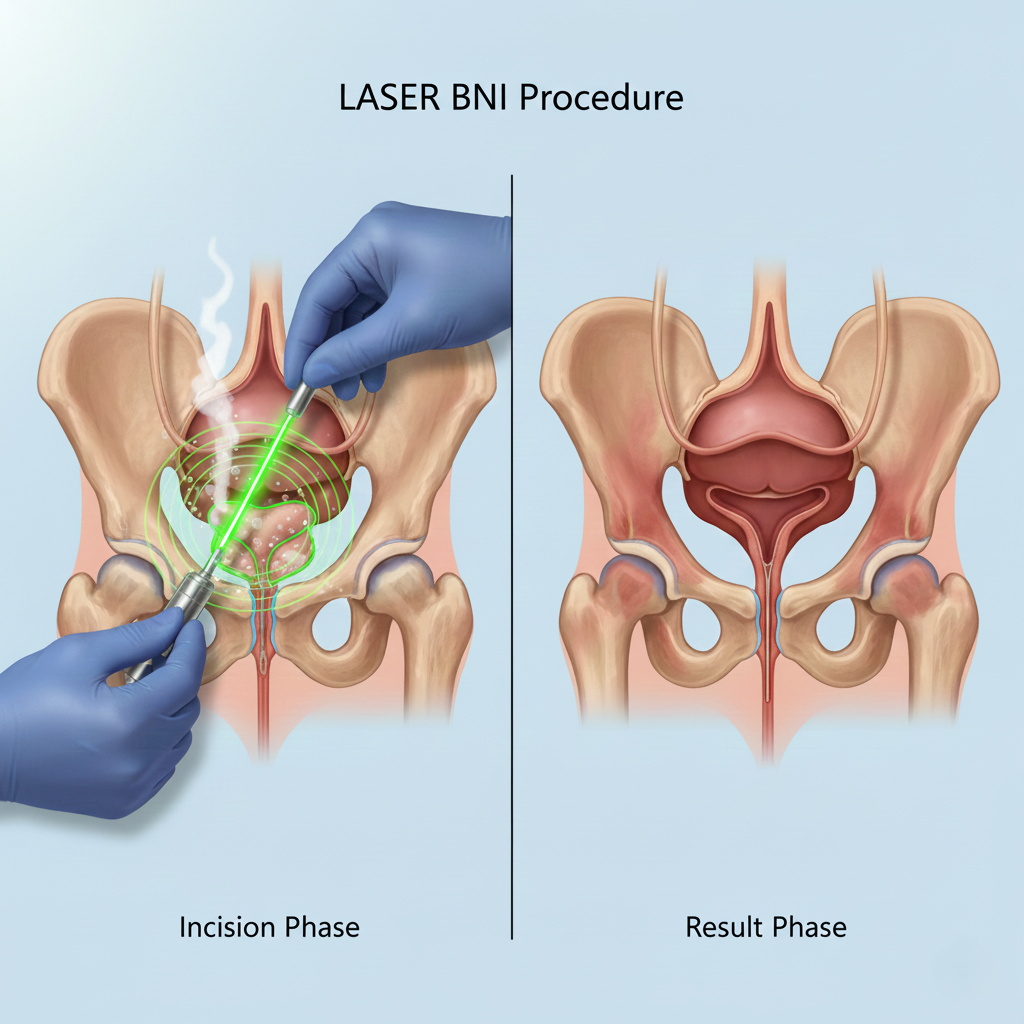
During the procedure, Dr. Singh uses a specialized laser fiber inserted through the urethra to make one or more precise incisions at the bladder neck and prostate. The laser energy instantly vaporizes and coagulates tissue, creating clean incisions that open the obstructed channel while simultaneously sealing blood vessels to prevent bleeding. These incisions are strategically placed at specific positions (typically at 5 and 7 o'clock positions) to maximize opening while minimizing trauma to surrounding structures. The immediate mechanical opening of the channel provides instant relief, and the body's healing process further improves the opening over the following weeks.
Laser BNI is particularly beneficial for men with smaller prostates (under 30-40 grams) who have significant bladder neck obstruction, young men (under 50) with primary bladder neck disease or obstruction, patients who have failed medication but don't have massive prostate enlargement, men who are sexually active and want to preserve ejaculatory function, or those on blood thinners who need a low-bleeding procedure. It's also excellent for patients with bladder neck contracture following previous prostate surgery or catheterization.
Before your Laser BNI treatment, Dr. Singh conducts a comprehensive evaluation including symptom assessment, prostate size measurement, uroflowmetry, and cystoscopy to visualize the bladder neck and prostate anatomy. You’ll receive detailed instructions about medications, fasting requirements, and what to expect. On procedure day, you’ll arrive at the hospital where you’ll receive either spinal or general anesthesia depending on your medical profile and preference. Pre-operative preparation takes about 30-45 minutes.
Under anesthesia, Dr. Singh inserts a specialized laser cystoscope through the urethra to visualize the bladder neck and prostatic urethra. Using high-powered laser energy (typically Holmium or Thulium laser), precise incisions are made at strategic positions to release the obstruction. The laser simultaneously cuts and coagulates blood vessels, resulting in minimal bleeding. The number and location of incisions depend on your specific anatomy—typically one to three incisions are sufficient. The entire surgical time is usually 15-30 minutes. A catheter is placed at the end of the procedure.
After surgery, you’ll recover in the post-anesthesia care unit for 2-3 hours while the anesthesia wears off. The catheter remains in place, draining urine and allowing the incisions to begin healing. Most patients are discharged the same day or after an overnight stay, depending on their comfort and urinary function. You’ll go home with the catheter (typically removed after 1-3 days), pain medications, and antibiotics. Follow-up is scheduled to monitor healing and remove the catheter.
This targeted surgical approach is ideal for specific anatomical situations—particularly smaller prostates with bladder neck obstruction. It provides immediate, dramatic symptom improvement (60-70% reduction in symptom scores) with minimal bleeding, preservation of ejaculatory function in 80-85% of cases, and rapid recovery. Same-day or next-day discharge is typical, with most patients returning to normal activities within 1-2 weeks. Primary Advantages: Minimal bleeding, quick procedure, same-day discharge, excellent for smaller prostates, preserves ejaculation in most cases, and immediate results.
TURP removes prostate tissue using electrical current and is the gold standard for larger prostates. While highly effective with 70-80% symptom improvement, it involves more bleeding, longer hospital stays (2-3 days), higher risk of sexual side effects (70-80% retrograde ejaculation), and longer recovery (3-4 weeks). TURP remains the preferred option for prostates over 60-80 grams.
These office-based procedures are excellent for preserving sexual function but work more gradually and may not be ideal for tight bladder neck obstruction. Laser BNI provides immediate surgical relief with minimal invasiveness—a middle ground between office procedures and major surgery.
Laser technology simultaneously cuts and coagulates blood vessels, resulting in virtually bloodless surgery—ideal for patients on blood thinners.
Unlike procedures that work gradually, Laser BNI provides instant mechanical opening of the obstruction—most patients notice dramatic improvement immediately after catheter removal.
The precise, limited incisions preserve ejaculatory function in 80-85% of patients significantly better than traditional TURP.
Same-day or overnight discharge with return to normal activities within 1-2 weeks much faster than traditional prostate surgery.
Schedule a private, confidential consultation with Dr. Singh in Indore.
Laser BNI is fundamentally different in approach and indication. While HoLEP (Holmium Laser Enucleation) and ThuLEP (Thulium Laser Enucleation) remove large portions of prostate tissue and are ideal for bigger prostates (50-150+ grams), Laser BNI makes strategic incisions without removing tissue—it’s specifically designed for smaller prostates (under 30-40 grams) with bladder neck obstruction. Think of it as precision incision versus bulk removal. Laser BNI is quicker (15-30 minutes vs. 1-2 hours), has faster recovery, and better sexual function preservation, but it’s only appropriate for specific anatomical situations. Dr. Singh evaluates your prostate size and obstruction pattern to determine which laser approach is optimal for you.
Laser BNI has excellent sexual function preservation compared to tissue removal procedures. Because the technique involves limited, precise incisions rather than extensive tissue removal, ejaculatory function is preserved in approximately 80-85% of patients—significantly better than traditional TURP (which has 70-80% retrograde ejaculation risk). Erectile function is typically unaffected as the nerves responsible for erections are located outside the surgical area. The risk of sexual side effects increases with more extensive incisions or if additional tissue removal is needed, but for most patients undergoing standard Laser BNI, sexual function remains largely intact. This makes it an excellent choice for younger, sexually active men.
Laser BNI is ideal when you need immediate, definitive surgical relief rather than gradual improvement. If you have a tight bladder neck obstruction or smaller prostate with significant symptoms that haven’t responded to medication, Laser BNI provides instant mechanical opening that office procedures may not achieve as effectively. While Rezum and UroLift are excellent for their minimal invasiveness and sexual function preservation, they work more gradually (weeks to months) and may not adequately address specific anatomical problems like bladder neck contracture. Laser BNI bridges the gap—it’s more invasive than office procedures but much less invasive than full tissue removal surgery, offering immediate relief with faster recovery than TURP.
Most Laser BNI patients are discharged the same day or after one overnight hospital stay, a significant advantage over traditional TURP, which typically requires 2-3 days. The catheter usually stays for 1-3 days and can often be removed during an office visit. Most patients with desk jobs return to work within 5-7 days, while those with physically demanding jobs should wait 2-3 weeks. This rapid recovery timeline is possible because Laser BNI creates precise incisions rather than removing large amounts of tissue, resulting in less trauma and faster healing. You’ll have specific activity restrictions for 2-3 weeks (no heavy lifting, strenuous exercise, or sexual activity), but overall recovery is much quicker than traditional surgery.
Yes, this is one of Laser BNI’s significant advantages. The laser energy simultaneously cuts and coagulates blood vessels, creating virtually bloodless surgery. This makes it much safer than traditional TURP for patients on anticoagulants or antiplatelet medications. Depending on your specific blood thinner and medical condition, Dr. Singh will coordinate with your cardiologist or primary physician to determine the safest approach—in many cases, you can continue some blood thinners through the procedure, or stop them for a minimal period. The reduced bleeding risk also means less need for blood transfusions, shorter catheter time, and faster recovery. If you’re on blood thinners for heart conditions, strokes, or clotting disorders, Laser BNI is often the preferred surgical option.
Laser BNI provides durable, long-lasting results for the specific problem it addresses—bladder neck and prostate obstruction in smaller glands. The incisions remain open permanently, so the immediate obstruction is resolved. However, because BPH is a progressive condition, the prostate may continue to enlarge over years or decades. If this happens, you might eventually need additional treatment. The good news is that Laser BNI doesn’t prevent future treatments—you can have repeat Laser BNI, progress to tissue removal procedures like HoLEP, or try other options. For most patients, especially younger men with primary bladder neck disease, the results are extremely durable, often lasting many years or permanently.

The leading center for advanced, compassionate urological care and treatment in Indore, Madhya Pradesh.