
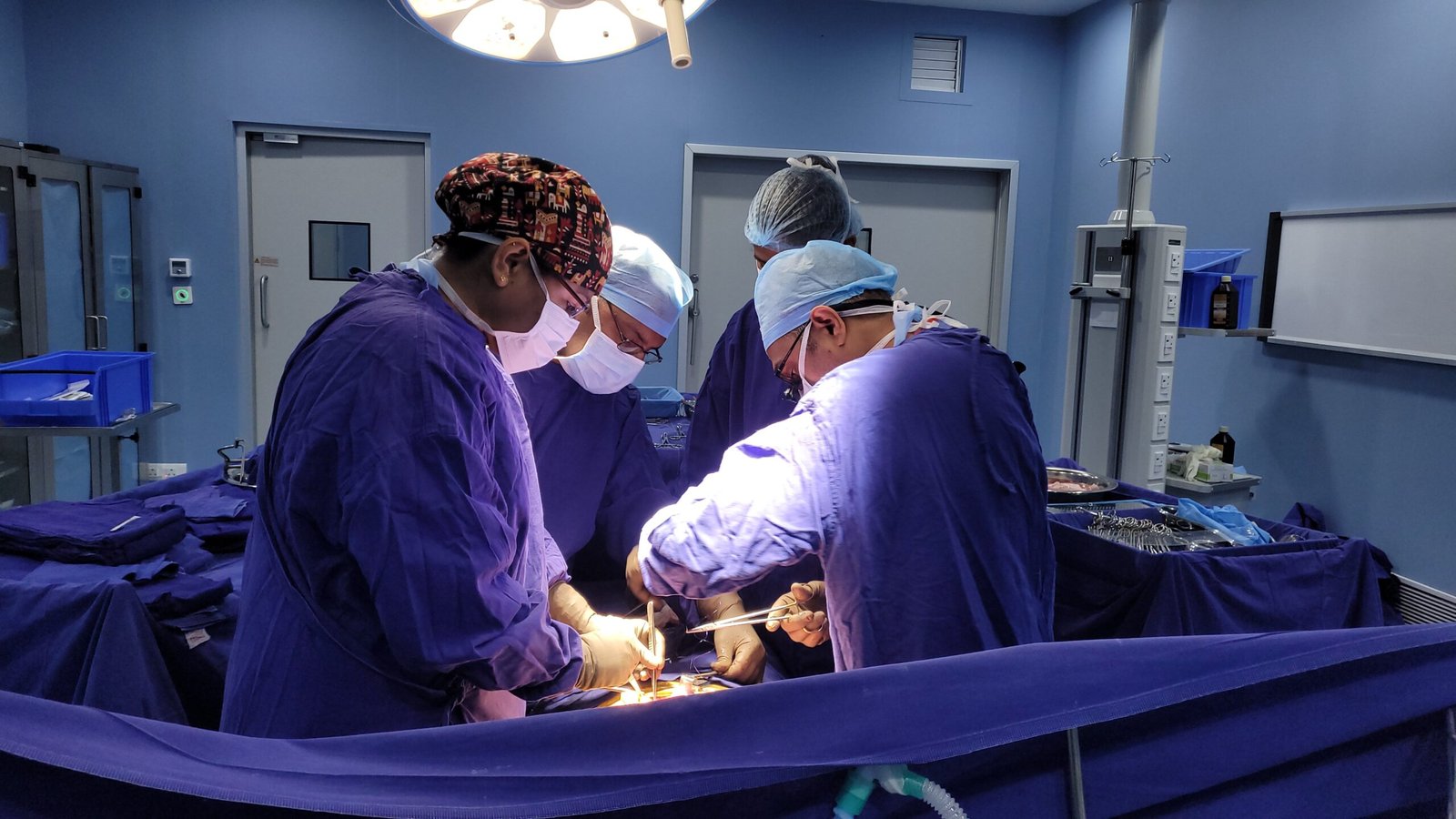
Robotics is changing the future of kidney transplantation and has the ability to change the future of different types of surgeries. The da Vinci robotic surgical system offers the opportunity to leave minimal scaring and offers the ability for a rapid recovery for the patient. Good news for patients with abdominal scar tissue; this option wasn’t available 10 years ago.
Robotic transplantation has the capability of connecting the renal vessels and ureters of the kidney to the pelvic structures of the recipient without the need of large incisions. It offers a minimally invasive option for patient with large abdominal incisions and a long recovery.
Robotic kidney transplant surgery is a minimally invasive technique for performing the recipient-side transplant surgery using a robotic surgical system. Traditionally, the surgeon would access the recipient’s pelvic blood vessels and bladder by making a large incision in the lower abdomen, but now the surgeon can complete the entire procedure using robotic instruments controlled from a console, through small ports.
Robotic kidney transplant surgery is a fairly new concept that was created to address one of the largest drawbacks associated with kidney surgery: the requirement for a large open incision on the transplant recipient. In traditional transplantation, the surgeon is required to connect the renal blood vessels and the ureter which lie deep in the pelvis. This requires a large incision and is often the most morbid aspect of the surgery especially for patients who are obese, as the pelvic tissue is deep and bulky.
Robotic surgery allows the surgeon to access the ports through small incisions and allows the robotic arms to work deep in the pelvis with precision and unparalleled freedom of movement that human hands cannot replicate. Through this form of surgery, recipients no longer have the large incision, but can still have the same surgical quality and care.
In developing robotic kidney transplant surgery, surgeons will operate from a console to control instruments, seeing inside the abdomen and pelvis in 3D HD, with highly precise movements and no tremors. The instruments have seven degrees of motion, similar to a highly dexterous human hand. This is especially useful in kidney transplant, where a surgeon will need to connect small blood vessels and an even smaller structure in the pelvis.
Normally, to give surgeons access to the pelvis, a large incision would be needed. However, with the robotics technology, the same connections can be made with a 1 cm incision (or smaller). The kidney would be placed through a cut made below the bikini line or at the navel, with the cut being 6-8 cm. Robotic tools will then be used to make all of the pelvis connections with the surgeon’s guidance, and a 3D HD view.
Connections in open surgery, where the renal artery and vein are connected to the iliac artery and vein, and the ureter is connected to the bladder, can all be done through a very small incision.
Difference Between Open, Laparoscopic & Robotic Kidney Transplant
It is vital to understand the terms ‘laparoscopic’ and ‘robotic’ relate to differing surgical systems, each with their own competencies, especially considering the intricate vascular connections needed in kidney transplant surgery. Below is a table outlining the primary differences between the three methods.
Feature | Open Surgery | Laparoscopic Surgery | Robotic Surgery |
Incision size | 20–30 cm flank incision | 2–3 ports + 5–7 cm extraction | 2–3 ports + small extraction |
Surgical vision | Direct – naked eye | 2D laparoscopic camera | 3D high-definition, 10x magnified |
Instrument movement | Unrestricted hand movement | Limited – fulcrum effect | Wristed instruments, 7 degrees of freedom |
Tremor filtration | None | None | Built-in motion scaling & tremor filter |
Blood loss | Higher | Low | Minimal |
Vessel/ureter repair | Good direct access | Technically demanding | Precise – ideal for delicate anastomoses |
Suitability for obese | Technically challenging | Challenging | Best option – deep pelvis access |
Post-op pain | Significant | Moderate to mild | Minimal |
Hospital stay | 7–10 days | 3–5 days | 2–4 days |
Return to activity | 6–8 weeks | 3–4 weeks | 2–3 weeks |
Performing laparoscopic vascular anastomoses without robotic assistance (pure laparoscopic kidney transplant) is one of the most difficult laparoscopic procedures due to the limited range of motion and the two-dimensional view. Because of this challenge laparoscopic kidney transplantation is rarely attempted even in transplant centers. The limitations of laparoscopic kidney transplantation are overcome by robotics. With robotic wristed instruments and 3D vision, surgery is possible on obese patients and patients of higher surgical risk.
The da Vinci Surgical System is comprised of components that include a console for the surgeon, a patient-side cart with robotic arms, and a vision system. It accounts for the majority of the robotic surgical systems utilized globally. The setup for robotic kidney surgical procedures consists of positioning the patient on the operating table with the surgical cart alongside them. Robotic ports are made in the lower abdomen and flank, and the kidney is placed through the incision made for extraction.
The console gives the operating surgeon a view with 3-dimensional high-definition images and can even allow the surgeon to see up to 10 times greater with depth perception, as opposed to the traditional, flat, laparoscopic camera. The da Vinci with robotic technologies allows the surgeon to make sutures a human hair width and place them in areas where a surgeons hand through a small incision could not fit. This system also captures the surgeon’s hand movements and transmits the movements to the robotic elements with a natural range.
All functions of the da Vinci system are performed by the operating surgeon. The systems enhance the surgeon’s ability, but do not serve to replace the surgeon’s judgment and expertise. That is why your robotic transplant’s success hinges on the surgeon’s skills, as the robotic systems are brought to their maximum potential.
Robotic kidney transplant has many advantages and great appeal for recipients who are obese, have undergone abdominal procedures before, and/or prefer shorter recovery times and less scarring. Here is a detailed description of the advantages of robotic surgical techniques for specific candidates:
Smaller Incisions & Minimal Scarring
For a traditional kidney transplant, a curved incision that stretches between 15 and 20cm must be made on the abdomen to access the vessels that are connected to the bladder. While the incision heals, this procedure leaves a significant scar – especially on patients who are considered obese due to the added pressure and thickness of an obese patient’s abdomen. In contrast, a robotic kidney transplant requires the use of 2 to 3 ports that are each less than a centimeter which, when combined with a bikini line incision in the range of 6 to 8 cm, leads to a transplant with a significantly lower visible scar. It also means less pressure on the incision and a dramatically decreased risk of surgical complications such as wound breakdown, especially in patients who are considered obese.
Less Blood Loss During the Procedure
The use of robotic methods results in an operative field that is dry and bloodless with superior visualization of all vessels. The surgeon has the ability to use a 3D, magnified view to address difficult issues with even the smallest of bleeding vessels. Robotic assisted kidney transplants experience lower intraoperative blood loss in comparison to surgeries that are performed via the open method. This decreases the requirement for blood transfusions. Blood transfusions carry the risk of a transfusion reaction and immune sensitization which can be more dangerous for individuals receiving organ transplants. Surgical blood loss is related to the recovery rate. If the blood loss is minimal during surgery, the body of the individual receiving the transplant is likely to recover more quickly from the surgery. This may also allow for a more rapid return of the individuals energy.
Lower Risk of Infection & Post-Op Complications
Incisions that are smaller in size creates less damage to the tissue, less dead space in the wound, and a smaller area for bacteria to enter. Compared to open surgery, rates for deep surgical site infection and wound infection are lower for surgeries that are minimally invasive. This becomes especially important for transplant surgery since the patient’s immune system becomes suppressed as a means to prevent the body from rejecting the new organs. There are greater risks for open surgery complications with an immunosuppressed patient, but robotic surgery for transplants greatly reduces the risk with smaller incisions, and tissue disruption.
Faster Recovery & Earlier Discharge
Due to the significantly smaller abdominal incision, those who undergo robotic kidney transplantation report less post-operative pain, are able to move about more quickly, initiate eating more rapidly, and leave the hospital sooner than those who have kidney transplants via the open surgical approach. The typical hospital stay for those transplant patients who had the open surgical approach is 7–10 days, while the average stay for those who had the transplant via the robotic approach is 3–5 days. Robotic transplant patients typically return to work and other activities of daily living in 2–3 weeks, while those who had the open transplant typically return in 6–8 weeks. For those of working age, and self-employed and who are parents of dependent minors, the quicker return to work is of great value.
Better Precision in Vessel & Ureter Connections
The hardest surgical challenge in a kidney transplant is the creation of the vascular anastomoses between the transplanted kidney’s renal artery and vein and the recipient’s iliac artery and vein, as well as the ureteroneocystostomy. For all of these connections, they must be watertight, free of tension, and be properly oriented to allow immediate blood perfusion and unobstructed drainage of urine. In a traditional open surgery, these connections would be made with excellent but unaided vision. Hand access would also be normal. In the robotic system, magnification, and three-dimensional depth perception, along with wristed instruments, allow the connections to be made in a more precise manner with significantly more advantages over traditional method. The risk of both vascular urinary leak and urine leak would also be greatly reduced.
Ideal for Obese & High-Risk Patients
One of the most clinically valuable benefits of robotic kidney transplant is how well it accommodates recipients who are obese – those who have a body mass index (BMI) greater than 30, and especially those exceeding 35. For obese patients, open kidney transplant surgery is especially difficult. The abdominal wall is thick, the depth of the surgery is greater, and wound complications are frequent, with a prolonged recovery period after the surgery. Some transplant centers will not offer a kidney transplant to an obese patient for these reasons, therefore, the patient is left on dialysis indefinitely. Because of robotic surgery, this is no longer an issue. The robotic tools can easily reach the pelvis with deep surgery and bowel thickness. There are fewer complications of the wound and a faster recovery time. It can be concluded that robotic surgery has improved kidney transplant options for patients who are obese that would have otherwise been denied, or have had their surgery options severely limited due to the increased risks.
In a living-donor kidney transplant, both performing donor and recipient surgeries are done side by side in separate operating rooms. The most common minimally invasive nephrectomy used today is laparoscopic or robotic laparoscopic donor nephrectomy. They are less invasive than open donor surgery.
Robotic Laparoscopic Donor Nephrectomy Procedure
Robotic laparoscopic donor nephrectomy combines minimally invasive nephrectomy with the precision and dexterity of the robotic system. The donor is placed under general anesthesia, and 3–4 small robotic ports are placed in the flank and abdomen. The da Vinci surgical robotic system allows the operator to visualize in three-dimensional, and with enhanced wristed instrument manipulability, the clinician can delineate the kidney from the surrounding peritoneal tissues, ligate and transect the renal pedicle and ureter, and perform the extraction through the small incision.
After extraction, the kidney is flushed with cold solution to reduce ischaemic injury and is given to the recipient team, which is in the next operating room. The robotic donor nephrectomy is generally 2–3 hours. The donor’s ports are closed with sutures and recovery is the same as described for laparoscopic donor nephrectomy.
With respect to laparoscopic donor nephrectomy, the robotic system approach is advantageous in that the dexterity of the system and precision of the system are of benefit in the presence of complex or multiple renal arteries or unusual anatomy. The robotic laparoscopic system tremor filtration and vascular magnification also reduces inadvertent vascular injury.
Safety & Recovery of the Kidney Donor
Safety of the donor is prioritized. At no cost should a donor’s safety be compromised. The use of robotic and laparoscopic nephrectomy is justified because they are the least unsafe techniques. These methods reduce trauma, bleeding, and complications to the donor when compared to the open method.
These donors are discharged from the hospital 2-3 days post-surgery. The majority of them only experience mild post-surgical pain that can be managed by taking oral medications. Typical time of getting back to work is 7 days. Completing untreated moderate to vigorous physical activity is possible in about a month. A single kidney already compensates the missing unpaired kidney by hypertrophy, a process that restores roughly 70-75% of the kidney’s overall function. Informed studies show that donors of kidneys live just as long as non-donors who are of the same age and background. Their quality of life is just as good.
Living Donor vs Cadaveric Donor – What You Should Know
Kidneys from either related or unrelated living donors are superior to kidney transplants from deceased donors for several reasons. First, living donor kidneys come from a healthy donor who has no health issues; deceased donor kidneys are healthy, obviously, but there are no assurances that the donor was healthy when they were alive. Additionally, the transplant surgery is scheduled; during the time between organ recovery and the transplant, the organ is at risk of cold ischemia; the kidney can be pre-emptively transplanted to avoid the patient needing dialysis; and the surgeon can perform HLA matching before the surgery. Following a living donor transplant, the graft will survive for 10 years, and 60–70% compared to deceased donor grafts at 50–60%.
There are important reasons cadaveric donor transplants should be left as an option. They are the primary option for patients with no available living donors. Cadaveric donor organs are also vital for patients with no available living donors. Organ allocation under India’s NOTTO/SOTTO (National and State Organ and Tissue Transplantation Organization) organ sharing framework prioritize deceased donor kidneys to patients based on blood group, time on the waiting list, and medical urgency). Dr. Vikas Singh’s transplant programme provides living and deceased donor transplants to all patients who are eligible and need transplants, ensuring no patients are unable to get a transplant due to the lack of a living donor.
Kidney transplant surgery is one of the highly complex urological procedures. The skills of the operating surgeon combined with the technology involved – in this case, the robotic system – along with the surgical experience and the number of surgeries performed, all contribute to the outcome of this surgery. The following factors are why the patients in Central and several other parts of India prefer Dr. Vikas Singh for kidney transplant.
Posted on GoogleTrustindex verifies that the original source of the review is Google. Dr vikas singh is best urologist in IndorePosted on GoogleTrustindex verifies that the original source of the review is Google. Nice treatmentPosted on GoogleTrustindex verifies that the original source of the review is Google. My treatment given by Dr vikas sir he is best doctorPosted on GoogleTrustindex verifies that the original source of the review is Google. Best doctorPosted on GoogleTrustindex verifies that the original source of the review is Google. Hm log shivpuri se dr vikas sir ko dikhane aaye, sir se milkar bahut acha lga, nature or treatment bahut sahi hePosted on GoogleTrustindex verifies that the original source of the review is Google. Nice doctorPosted on GoogleTrustindex verifies that the original source of the review is Google. Very experienced and caring doctor. Excellent treatment and patient-friendly approach. Highly recommended.”Posted on GoogleTrustindex verifies that the original source of the review is Google. On dt27.06.2026 dr.vikas singh performed my prostatomegaly surgery by Urolift method . I am now fealing very well.Within two days l got discharged from Kokilaban Dhirubhai Ambani hospital Indore (MP).I am very thankfull to this very new method Urolift,Dr.Vikas singh sir and BCM Kokilaben Dhirubhai Ambani hospital,Nipania Indore. ByAdarsh kumar pauranik.Posted on GoogleTrustindex verifies that the original source of the review is Google. Good experience for testis treatment for my son
In a da Vinci robotic kidney transplant surgery, surgeons do the recipient operation using robotic systems to place and connect the transplanted kidney through keyhole incisions. Open surgeries leave large gaping wounds, but robotic systems go as small as 10x magnified keyhole incisions. The systems Vascular instruments provide precision for deep pelvic vascular connection. Traditional surgery leaves patients with a 15–20 cm lower abdominal incision and 7–10 day long hospital stays with a long recovery period of 6–8 weeks. Robotic systems reduce hospital stays to 3–5 days, recovery to 2–3 weeks and leave much smaller ports than traditional systems.
Almost all adult candidates for kidney transplants can get the surgery done using the robotic method. This method of surgery is particularly useful for patients who are on the obese side (BMI above about 30-35) and run a greater risk of wound complications due to open surgery. It is also useful in patients who have had a previous surgery on the lower abdomen and pelvis and, therefore, an open dissection will be more difficult. The robotic method also helps patients who want to reduce the time it takes to recover from the surgery and those whose concern about the scarring is elevated. In some cases, patients who have very severe peritoneal adhesions from previous surgeries in the abdomen are better off with the open method. The best way to find out if the method is appropriate is to book a consultation with Dr. Vikas Singh, who will study your anatomy, BMI, past surgeries, and condition in order to decide which method of transplant is best.
Yes. Dr. Vikas Singh offers robotic kidney transplant surgery at Kokilaben Dhirubhai Ambani Hospital, Nipania, Indore. This advanced technology is now available to patients in Central India without having to go to Delhi, and Mumbai. This is one of the few centers in Madhya Pradesh and in Central India which offers robotic kidney transplantation.
No. A kidney does not care whether the surgery to implant it was done robotics style or by the good old open method. The quality of kidney function depends on the quality of the kidney (depends on the donor’s health and the time the kidney was cut off and then re-implanted), the quality of the blood vessel connections, and the receiver’s immune response. The robotic style helps make the connections with more precision, and so it probably helps make blood vessel and ureter connections with fewer complications. Studies from robotic transplant centers that perform a high volume of transplantations report that the long-term results of robotic kidney transplantation show grafts surviving better than, or at least equal to, open kidney transplants.
When performed by experienced surgeons, robotic kidney transplants take between 3–5 hours. Donor operations, either laparoscopic or robotic nephrectomies, take about 2–3 hours. The two procedures are arranged such that teams meet when the donor nephrectomy is completed and the recipient team is ready to receive the kidney transplant, preserving the optimal condition of the kidney. Optimal ischaemia is achieved when the kidney is least exposed to injury. Complex recipient anatomy and BMI can prolong the time needed to complete the transplant.
General anesthesia is part of robotic kidney transplant surgery. Patients are entirely unconscious and unable to feel pain during the procedure. The anaesthetic staff take care of and monitor patients’ vital signs and fluid balance. This is especially crucial for kidney transplant operations. The small incisions made in robotic surgery incite significantly less trauma and pain compared to the open method. This allows pain to be very well controlled after surgery. Most patients feel well enough to be up and moving about within a day of having robotic kidney transplant surgery.
Because robotic-assisted spans tool use, single-use implements, and longer operating times, the cost of robotic kidney surgery is more than conventional open surgery. Some of the costs, however, are offset by less time in the hospital, fewer complications, and quicker recovery times. The ultimate cost is contingent on the case complexity, kidney donor type, hospital stay, and post-op requirements. After the initial consultation, the transplant coordinator for Dr. Vikas Singh can provide the price for the surgery. Health insurance for robotic kidney transplant surgery is advisable. Ensure to discuss with your insurance before the procedure.
Redo kidney transplantation occurs when a first graft fails and a subsequent transplant is required. Due to previous surgical scarring, redo kidney transplantation becomes surgically challenging. However, in select cases, robotic transplant surgery can overcome these challenges as superior visualization and instrumentation allow for the robotic system to safely navigate through scar tissue. Each case is assessed individually and Dr. Vikas Singh has extensive experience in challenging kidney transplants allowing him to evaluate your anatomy and assist in determining the best course of action.
Prevention of rejection after robotic kidney transplant is the same as that after open kidney transplant because the immunological relationship between kidney transplant recipient and the recipient’s immune system does not change with the method of transplant. Rejection is basically prevented with lifelong immunosuppresant medications that include a cocktail of tacrolimus, mycophenolate mofetil and low-dose prednisolone. The doses of these drugs are closely monitored with regular tests for blood levels of these drugs to keep the rejection risk and over-suppression of the immune system in check. The risk of rejection is also reduced through pre-transplant cross-matching and typing for HLA to ensure immunological compatibility of the donor and recipient.