
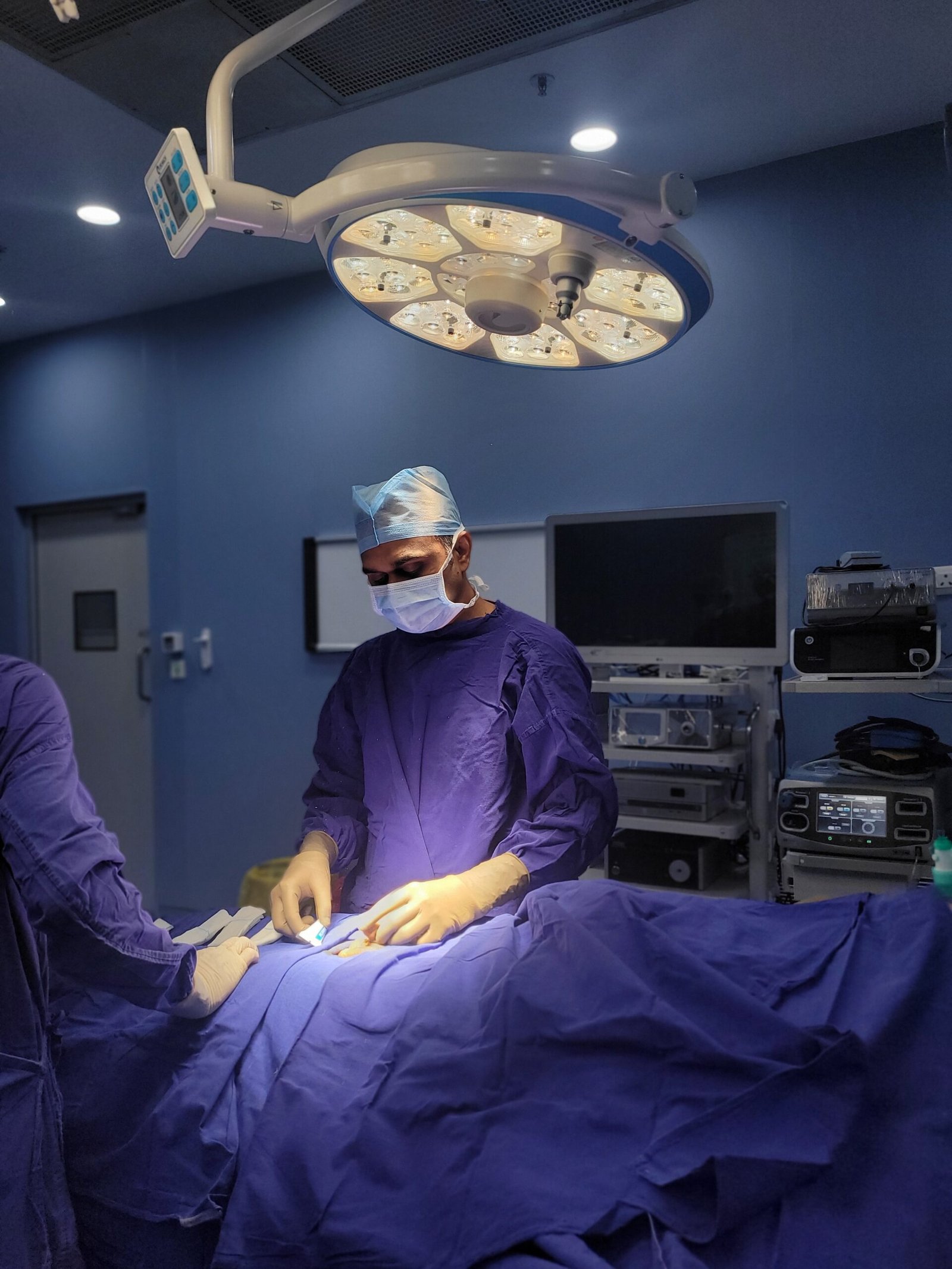
Sometimes, kidney stones cannot be removed through the urethra by a scope. They can be too large, too hard, and too complex, or they occur in regions where a flexible scope cannot reach. For many decades, the removal of these stones would require the surgical removal of a kidney. This would result in a 10 to 15 cm cut in the kidney’s flank and a long recovery in the hospital and weeks of missed work. This process was revolutionized by PCNL.
Percutaneous Nephrolithotomy (PCNL) is a minimally invasive, keyhole surgical technique for removing large and complex stones. Instead of large surgical incisions, a single small incision (about 1cm) is made on the back and the kidney. The scope is a nephroscope, and is set through the incision. Although the incision is small and keyholed, the stones can be broken with a laser or a pneumatic lithotripter, and the broken stones can then be extracted. This cleared the previously unmanageable, large, and complex stones. The incision was small enough that a ten-rupee coin can cover it.
PCNL refers to a technique for removing kidney stones in which an incision less than 1 cm is made alongside the spine to gain direct access into the kidney. This incision is for insertion of a nephroscope into the kidney. The nephroscope is a type of telescope used in the kidney, allowing the surgeon to use laser or pneumatic technology for stone fragmentation and evacuation. The procedure is done through the renal pelvis of the kidney and involves minimal other body tissue laceration other than small skin incision, and minor controlled dilation of the renal capsule.
PCNL is the most effective technique for large stones (>2 cm) in the kidney. It is the most appropriate method for staghorn stones (total renal calculus), multiple renal calculi, resistant stones which are not amenable to laser lithotripsy, and stones in patients with anatomical challenges which complicate or make ureteral access dangerous.
PCNL differs from RIRS and URSL in that the latter techniques access the kidney from the urethra and the former accesses the kidney from the kidney’s posterior aspect via the skin. PCNL is capable of removing several large stones in one session through the use of a large nephroscope to perform renal if ureteral techniques are not.
In PCNL, patients are set face-down on the operating table. This allows the surgeon to make an incision on the patient’s back for access to the kidney. Prior to an incision, the doctor needs to determine the kidney’s anatomy. This can be done using a fluoroscope to produce an image by X-rays. The C-arm is a tool that is a more mobile option for fluoroscopy. Dr. Vikas Singh can position the kidney using the C-arm and determine the stone’s location to choose the optimal access for the kidney’s calyx.
A thin needle, a Chiba needle, is used to penetrate the skin, back muscle, and the kidney. Fluoroscopy is used to determine the moment the Chiba needle punctures the kidney. This is also determined by the appearance of urine or dye flowing from the kidney back to the outside. This would be the optimal time to insert a guidewire through the Chiba needle.
After the guidewire is placed, the needle is removed, and a series of progressively larger dilators are placed along the guidewire and used to stretch the puncture tract to a larger diameter. For standard PCNL, the tract is dilated to 24 to 30 French, which is about 8 to 10 mm. For Mini PCNL, the tract is 14 to 20 French, and for Ultra Mini PCNL, the tract is 11 to 13 French. To maintain this dilated access for the remainder of the procedure, an Amplatz sheath is placed along the tract. The sheath is a rigid plastic sheath and is the channel through which all of the instruments used for the procedure pass along.
Creating the access tract takes 10 to 20 minutes and is one of the more challenging and skill-based portions of performing PCNL. Choosing the correct and most appropriate calyx, puncturing the calyx, and then safely performing the tract dilatation is critical. One of the primary factors that determines the safety and speed of the entire PCNL is Dr. Vikas Singh’s skill and experience with PCNL.
After the access tract has been established and the Amplatz sheath has been set, the nephroscope, which is a rigid, short telescope fitted with a large working channel, is placed in the sheath and advanced into the kidney. The nephroscope enables a wide-angle view and provides a working channel through which stone breaking instruments can be placed.
In modern percutaneous nephrolithotomy, the Holmium:YAG laser fibre is the lithotripter of choice and is extremely effective with stones of all compositions. A pneumatic lithotripter, which uses a pulse of compressed air, can be used together with the laser when dealing with very large stones (especially those larger than 3-4 cm) to maximize efficiency. Advanced centers may also utilize an ultrasonic lithotripter which breaks the stone and subsequently aspirates the stone fragments.
Stone fragments can be removed through the sheath using a variety of mechanisms, including, direct suction, forceps, stone baskets, or a nephroscope. In the case of a large stone burden, Dr. Vikas Singh may choose to rotate the nephroscope in order to access multiple calyces via a single access tract, or he may choose to perform a second access tract to reach stones that are not accessible via the first tract and are obstructed from view through the nephroscope.
At the end of the surgery, after complete stone clearance is verified by fluoroscopy (and after a nephrostogram – wherein contrast is injected through the tract to show the collecting system), the tract is dealt with depending on the chosen PCNL type. A nephrostomy tube is placed for standard PCNL, a DJ stent is placed for tubeless PCNL, or the tract is directly sealed with no drainage (in a select few totally tubeless instances).
PCNL is the first-line choice for surgical management of renal stones greater than 2 cm diameter. For stones above 2 cm, evidence shows PCNL provides the best one-session stone-free rates, at 85 to 95%, compared to RIRS, at 60 to 80%, and the ESWL stone-free rate remains ineffective above 1.5 to 2 cm. For the patient, PCNL is advantageous, as the burden of treatment, in terms of anaesthesia, hospital stay, and surgery, is the least – one compared to multiple.
A staghorn calculus is a type of kidney stone that occupies the entire renal pelvis and extends into several kidney calyces. They resemble a stag’s antlers on an X-ray. These extensive stones take up the entire kidney collecting system and cause the obstruction of collecting system stones. Staghorn stones are treated almost exclusively by PCNL. Deferring to other urolithiases, staghorn stones require the most amount of PCNL effort, and clearance is often only achieved by multiple access tracts and/or multiple PCNL sessions spaced a few weeks apart. In India, staghorn stones are the leading cause of the destruction of a kidney in the developing stone by the slow process of renal infection and pyelonephritis.
When several large calculi form in different segments of a single kidney, nephroscopic access through the kidney to treat each stone one after the other is possible with PCNL. This is extremely beneficial when the stone burden is large to the point that multiple RIRS sessions would be required, or the calculi are too large or too hard making laser fragmentation through a flexible ureteroscope infeasible.
There are patients who have residual stones after undergoing procedures such as ESWL or RIRS. These stones are often left behind because of their hardness, size, or a location the scope cannot reach. In these cases, stones can be completely cleared with PCNL. PCNL clears the obstacles that block procedures like those mentioned above. Through a percutaneous puncture, PCNL can reach all complex spaces.
Some anatomical features make traditional ureteroscopic techniques difficult or unfeasible. A horseshoe kidney (two kidneys fused at their lower poles) will have an altered orientation which will make ureteroscopic access difficult but is palliative to PCNL after an access plan is created. Individuals with a prior history of urinary diversion surgeries, ureteral reconstructions, and other pelvic operations which have disrupted the typical urinary anatomy, will most likely need PCNL to gain access to the renal calculus.
Stones in the kidney that are larger than 2 cm (considered large) will cause flank pain that is often dull and deep and cause pain that is often persistent. This occurs because the stone in the kidney constantly stretches the kidney’s collecting system and the pain will often be felt for months if not years. Also, some large kidney stones will cause no pain and that is why it is essential to regularly take images to look for known stones. This is even if the stones are known or pain is not present.
Infection stones and staghorn calculi turn kidneys into a chronic site of bacterial colonization. Stones that persistently harbor bacteria induce recurrent fevers, chills, and visceral pain that constitute a febrile urinary tract infection. Even prolonged courses of antibiotics will only temporarily eradicate these infections. Extraction of the stone is the only way to eradicate the chronic infection. Since PCNL clears the stone, it also clears the source of recurrent infection.
Large kidney stones can cause blood to appear in urine as the stones shift throughout the kidney and cause damage to the lining. This can be called stone migration and the presence of blood can be visible in the urine or be present in only microscopic quantities. When blood appears in the urine as a result of kidney stones, it can typically be classified as a non-urgent injury. It also serves as a reminder to the patient and physician o helps explain the need for a more effective, definitive treatment, as the stones are continuously affecting the patients kidney.
A large stone that completely or partially blocks the kidney’s outflow obstructs and gradually injures the kidney’s filtering units causing backpressure to the various glomeruli and tubules. Over months or years, the backpressure further diminishes the affected kidney’s ability to function. Rising blood levels of creatinine or a nuclear kidney function scan (MAG3 renogram or DTPA) showing progressive decline in differential function in the stone-affected kidney are objective ways to confirm that PCNL should urgently be performed to avoid further permanent loss of renal parenchyma.
A stone that causes complete blockage of the kidney’s drainage is a urological emergency. With infection, the patient is at high risk of urosepsis within hours. Complete blockage without infection still causes rapid damage to the kidney. Urgent decompression of the kidney is required that can be achieved by a specially designed nephrostomy tube. Dr. Vikas Singh is an expert in performing nephrostomy tubes. He will perform a nephrostomy tube placement, and then perform the stone extraction, PCNL (Percutaneous Nephrolithomy) once the patient is stable.
Standard PCNL uses the widest access tract – 24 to 30 French (about 8 to 10mm). This permits the largest nephroscopes, widest working channels, and most powerful lithotripters to be harnessed inside the kidneys. For staghorn calculi, and stones above 3 to 4 cm, and complex multi-calyx stone burdens, standard PCNL provides the best single session stone free rates and instrument access. The larger stone fragments can be extracted and are removed faster, decreasing the operative time required for very large stones in comparison to the mini PCNL approaches.
A standard nephrostomy tube is usually left behind in the kidneys after standard PCNL. This tube is a rubber or silicone tube that exists and drains into an external bag for 24 to 48 hours. This tube permits drainage for blood stained urine, to aid in kidney irrigation, and provides access for a second look nephroscopy (a quick look the following day under X-ray) that is usually done to assess for complete stone clearance or to remove any previous single look nephroscopy fragment that was left behind.
Mini PCNL employs a 14 to 20 French (5 to 6mm) tract and smaller nephroscopes and instruments. With smaller access used during PCNL, nephrostomy tube-related discomfort, and blood loss and pain after surgery are decreased. Stone clearance is maintaining almost similar to standard PCNL for most stone sizes (up to 3cm) with marginal loss.
At Kokilaben Hospital, Dr. Vikas Singh endorses Mini PCNL for most patients because stone clearance, safety, and recovery is favorable. The tract size is associated with less tail and long-termed preservation of kidney function, i.e. the kidney tissue (parenchyma) is minimally impacted through which the tract passes, and because the tract is less, the external scar is smaller.
Ultra Mini PCNL break the frontiers of traditional PCNL. They are used for stones of size 1.5 to 2.5 cm in meticulously chosen patients with favorable anatomy. The blood loss is negligible, post-op pain is extremely low, and often patients are discharged within 24 hours. Additionally, stones are often cleared with the greatest stone-free rates due to the minimized invasiveness of the procedure.
Ultra Mini PCNLs have highly restrictive working channels which limits the techniques that can be performed, increasing usage time for fragmentation of a difficult stone and the possibility that a second surgery for stone removal is required. Thus, great consideration is required in choosing to use Ultra Mini PCNLs. They are a great tool for use in stones of a moderate size with a clear anatomical burden, but are not appropriate for use with an excessive stone burden.
In all of the above PCNL variants, nephrostomy, an external drainage tube from the kidney to an external bag, has traditionally been employed. In tubeless PCNL, a nephrostomy tube is omitted, and only a DJ stent is left to drain the kidney internally. Tubeless PCNL is a modification of PCNL.
From the patients’ perspective, tubeless PCNL has fewer external tubes protruding from the back, no external urine bags, a substantial decrease in post-operative pain and care, and an overall reduction in the time spent in the hospital following surgery. Most patients can be discharged in less than the traditional 24- to 48-hour post-operative period.
This technique is best suited for patients with uncomplicated PCNL cases with minimal intra-op/inter-op bleeding, confirmed complete clearance of the kidney of stones with no suspected or significant residual, small, presumed urine leak, and a patient in good health. Tubeless techniques are inappropriate for patients with significant post-operative bleeding, respiratory infection, complete intra-op clearance, and suspected leak. Final determination of tubeless technique is made by Dr. Vikas Singh, based on intra-operative findings.
When it comes to complex or ‘staghorn’ type of kidney stones greater than 2 cm with a calyx component, the best treatment to use is PCNL (percutaneous nephrolithotomy). There is currently no other minimally invasive technique that is able to do the same level of lithotripsy and mass removal of kidney stones in a single session. This technique provides the best method to achieve a somewhat invasive kidney stone removal through direct access to the kidney with a single small incision as opposed to a large surgical incision.
In experienced centers, single-session PCNL achieves stone-free rates of 85% to 95%. For stones larger than 2 cm, ESWL stone-free rates are as low as 20% to 40%, while RIRS stone-free rates achieve 60% to 80%. RIRS techniques often require several sessions for very large stones. For patients who desire to resolve the concern definitively in one procedure, PCNL is the most successful option.
Staghorn stones are some of the most complex calculi that present in urology. Due to their large size and propensity to cause infections, they can occupy the entire collecting system of the kidney. The only approach available to the urologist to effectively treat this kind of calculus is direct percutaneous access. With the introduction of PCNL, this can be done without the extensive trauma associated with open surgery. Even large staghorn stones can be completely cleared with PCNL, often in two staged sessions carried out a few months apart, and the kidney can be restored to a stone free state allowing the infected tissue to recuperate to normal.
The adoption of Mini PCNL and Tubeless PCNL has significantly decreased the PCNL-associated hospital stay. With the standard PCNL, the hospital stay used to be 5 to 7 days with a large nephrostomy tube. However, Mini PCNL patients at Kokilaben Hospital are discharged, on average, in 1 to 3 days. Tubeless PCNL patients are sometimes discharged in as little as 1 day and no more than 2 days. This advancement in the procedure also means PCNL is much more acceptable to patients who previously had a negative perception of the long and psychologically difficult “kidney surgery” recovery.
Over time, big kidney stones, if not treated, can damage the kidney. The damage may be due to infective and non-infective obstruction and direct damage to the collecting system. Due to complete stone clearance, PCNL halts the damage and recovers the kidney even if the kidney had some loss of function. Many studies show that PCNL improves the function of the kidney as opposed to the significant preoperative obstruction measured by MAG3.
Posted on GoogleTrustindex verifies that the original source of the review is Google. Dr vikas singh is best urologist in IndorePosted on GoogleTrustindex verifies that the original source of the review is Google. Nice treatmentPosted on GoogleTrustindex verifies that the original source of the review is Google. My treatment given by Dr vikas sir he is best doctorPosted on GoogleTrustindex verifies that the original source of the review is Google. Best doctorPosted on GoogleTrustindex verifies that the original source of the review is Google. Hm log shivpuri se dr vikas sir ko dikhane aaye, sir se milkar bahut acha lga, nature or treatment bahut sahi hePosted on GoogleTrustindex verifies that the original source of the review is Google. Nice doctorPosted on GoogleTrustindex verifies that the original source of the review is Google. Very experienced and caring doctor. Excellent treatment and patient-friendly approach. Highly recommended.”Posted on GoogleTrustindex verifies that the original source of the review is Google. On dt27.06.2026 dr.vikas singh performed my prostatomegaly surgery by Urolift method . I am now fealing very well.Within two days l got discharged from Kokilaban Dhirubhai Ambani hospital Indore (MP).I am very thankfull to this very new method Urolift,Dr.Vikas singh sir and BCM Kokilaben Dhirubhai Ambani hospital,Nipania Indore. ByAdarsh kumar pauranik.Posted on GoogleTrustindex verifies that the original source of the review is Google. Good experience for testis treatment for my son
The procedure is done using a general anesthetiic. This means that during the procedure you will be awake. However, if you are experiencing pain post-op, please do not hesitate to ask for pain relief and it will come in injeciton and pill form. Post-op pain at the nephrons is expected and it typically feels like a bruise. If a nephrostomy is put in, this will add more pain. This is another reason why we do Tubeless PCNL when we can. With Standard PCNL, most patients will have post-op pain for about 3 to 5 days. Mini and Tubeless PCNL typically is 2 to 3 days.
How long the procedure takes depends on the size and complexity of the stone, and how many access tracts are needed. Large stone with uncomplicated anatomy may cost 60-90 minutes with Mini PCNL. For more advanced stone anatomy such as complex staghorn and multi-calyx stones requiring multiple access tracts, the time increases to 90-150 minutes with PCNL. For complicated large staghorn stones a more reasonable option may be pairing the treatment with 2 staged sessions rather than a large back to back single session.
A nephrostomy is a drain placed at the end of a PCNL that goes through the inner layer of the posterior abdominal wall to an external drainage bag. This drain is a rubber or soft drain. This allows the surgeon to place a second nephroscopy to the kidney through the nephrostomy and assess the stone clearance. This now allows for a day of the kidney to drain free and also allows for irrigation. A nephrostomy stays for 24-48 hours and is removed post-procedure. This is done during a standard PCNL. Some PCNL will use internal DJ stents. A Mini PCNL also uses a smaller drain or alternative. During a Tubeless PCNL, a nephrostomy is not placed.
In nearly all PCNL cases, including Tubeless PCNL, a DJ stent is inserted at the conclusion of the surgery. The stent is used to keep the ureter patent in the immediate post-operative period to allow for the drainage of stone dust, clot, or small tissue fragments from the kidney to the bladder. The DJ stent is extracted at a quick outpatient appointment 2 to 4 weeks after PCNL.
Yes. PCNL is the only procedure that can do near-complete clearance of staghorn calculi and is minimally invasive. Staghorn stones that are exceptionally large may need to be done in two PCNL sessions (staged procedures) 3 to 4 weeks apart to achieve near-complete clearance, after each session, the remaining stone burden. After the successful PCNL procedure, the majority of patients after staghorn stones experience the decrease of their chronic infections and stabiliation of the functioning of their kidneys. Despite this, staghorn stones can come back if the underlying urinary infection is allowed to continue. In these cases, long-term urological follow-up and antibiotic management are very important.
For large ureteric stones, a laparoscopic ureterolithotomy, and for kidney stones, a laparoscopic pyelolithotomy can be performed. Laparoscopic techniques require a general anaesthetic and a few small incisions, with access through the front or side abdomen to reach the ureter or kidney directly. Laparoscopic renal stone surgery is no longer in demand, as PCNL (Percutaneous Nephrolithotomy) has an easier, better, and time-tested approach with a large stone clearance. In select circumstances/modalities, laparoscopic renal surgery can be performed for stones located in part of the renal orthotopic system and potentially in stones that may be deemed removed through an endoscopic approach to the renal system.
PCNL can be done on patients who have one working kidney, be it due to congenital reasons such as agenesis, or the removal of the opposite kidney. PCNL in such patients must be done with extreme caution to minimize as much as possible any bleeding, and also to manage post-op obstruction as having even minor damage to a solitary kidney is far more serious compared to having damage to a patient’s both kidneys. Dr. Vikas Singh performs PCNL on solitary kidney patients with the following considerations in mind: careful assessment, exacting bleeding control, post-op careful observation, and the use of a tract size that is the least in both diameters and lengths. The use of a nephrostomy tube post-op to PCNL in a solitary kidney patient is a necessity to assist in the drainage of the kidney to minimize post-op obstruction and aid healing.
After a Mini PCNL or Tubeless PCNL, most patients with light, desk-type jobs are able to return to work in 7 to 10 days. After a PCNL done for larger or more complex stones, 10 to 14 days off is usually needed. In patients with demanding work that includes lifting, construction, farming, etc., strenuous work should be avoided for 3 to 4 weeks for the puncture tract in the kidney to heal.
Although most centres avoid it for obvious reasons, performing a Bilateral Simultaneous PCNL (PCNL on both kidneys at once in the same anaesthesia session) is technically possible. Most urologists opt for staged bilateral PCNL (operating on one kidney, waiting 4 to 6 weeks for complete recovery, and then operating on the remaining kidney). While there are rare and specific circumstances (i.e. motivated patients having symptoms due to bilateral stones with sufficient physiological capabilities), there is generally no reason to consider performing simultaneous bilateral PCNL.