Dr. Vikas Singh is a highly distinguished Consultant Urologist and Kidney Transplant Surgeon in Indore, recognized as one of the youngest surgeons in India to achieve the milestone of 100 individual kidney transplants early in his career. With a cumulative experience of over 500 kidney transplant procedures across premier institutions like PGI Chandigarh, Max Super-Speciality Hospital New Delhi, and SMS Medical College Jaipur, he brings world-class expertise to Central India. Now practicing at Kokilaben Dhirubhai Ambani Hospital Indore, Dr. Singh specializes in both conventional and cutting-edge Robotic-Assisted Kidney Transplant surgery—a minimally invasive approach that offers patients faster recovery, reduced pain, and excellent graft outcomes. His comprehensive transplant program manages the entire journey from pre-transplant evaluation and donor workup to post-operative care and lifelong follow-up, ensuring the highest success rates and quality of life for transplant recipients. We provide complete transparency regarding treatment costs and facilitate seamless coordination with insurance providers and government schemes for our patients throughout Central India.
Cumulative experience of over 500 kidney transplant surgeries across India's premier transplant centers.
Youngest surgeon in India to individually complete 100 kidney transplants demonstrating exceptional skill and dedication.
Advanced expertise in robotic-assisted transplant surgery offering superior cosmetic results and faster recovery.
Kidney transplant becomes the optimal treatment when patients reach End-Stage Renal Disease (ESRD) requiring dialysis. Transplantation offers significantly better quality of life, longer survival, freedom from dialysis schedules, fewer dietary restrictions, and lower long-term costs compared to lifelong dialysis. It's the definitive cure for kidney failure.
Living Donor Transplant involves receiving a kidney from a healthy living person (typically family member or spouse), offering better outcomes and shorter wait times. Deceased Donor Transplant involves receiving a kidney from a brain-dead donor through government organ allocation programs. Living donor transplants generally have better long-term success rates and can be scheduled electively.
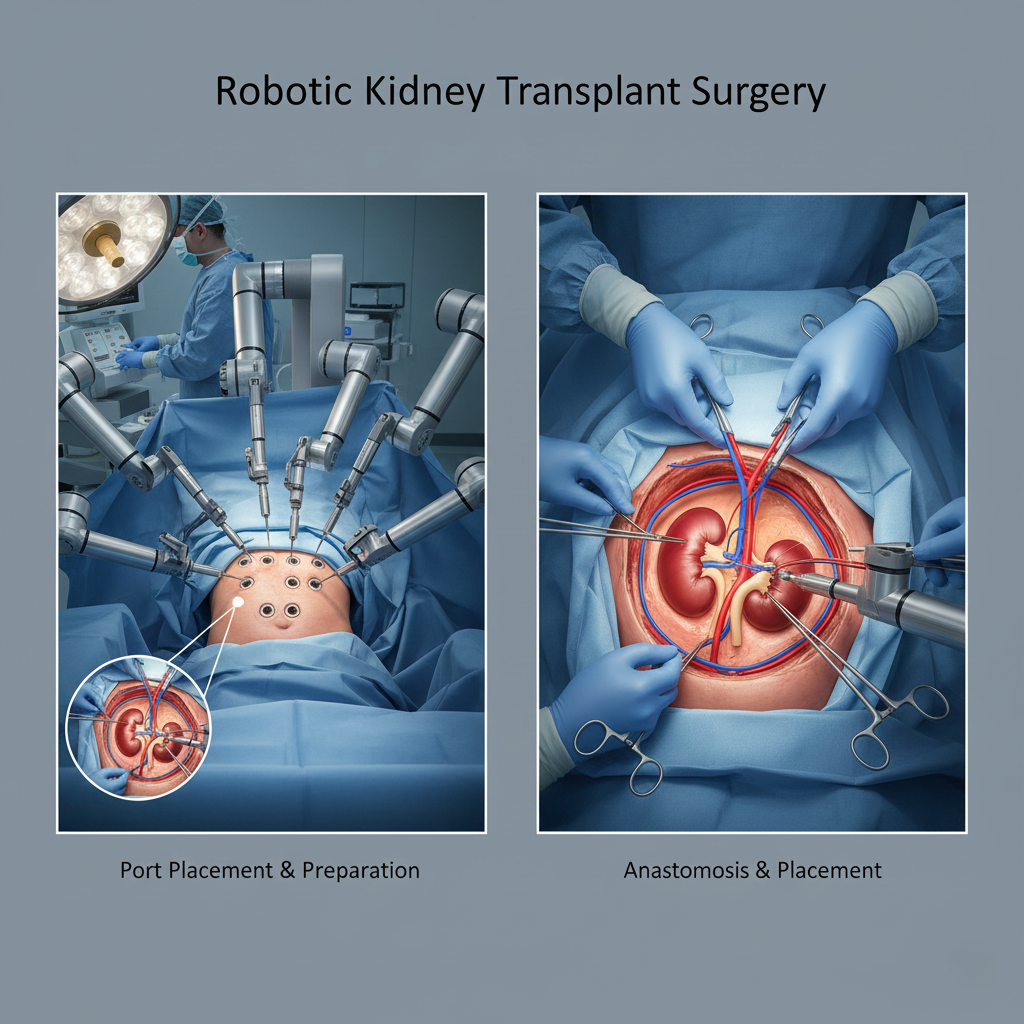
Robotic-Assisted Kidney Transplant represents the latest advancement in transplant surgery. Using the Da Vinci Robotic System for recipient surgery, Dr. Singh can perform the complex vascular connections and ureter anastomosis through small incisions with enhanced 3D visualization and precision. This results in reduced pain, minimal scarring, faster recovery, and shorter hospital stays compared to traditional open surgery—all while maintaining excellent graft function.
Both recipient and donor undergo thorough medical evaluation including blood tests, tissue typing (HLA matching), cross-matching, viral screening, cardiac evaluation, and psychological assessment. This comprehensive workup ensures surgical safety and optimal transplant outcomes. The process typically takes 2-4 weeks for living donor transplants.
For Robotic-Assisted transplant, the recipient surgery is performed through small incisions using the Da Vinci robot. The donor kidney is placed in the lower abdomen (iliac fossa), and its blood vessels are connected to the recipient’s iliac vessels with microscopic precision. The ureter is connected to the bladder to drain urine. The surgery typically takes 3-4 hours. Donor surgery (for living donors) is performed simultaneously or sequentially, increasingly using laparoscopic or robotic techniques for donor comfort.
Immediately after surgery, patients are monitored in the ICU or specialized transplant unit. The new kidney typically starts functioning within hours to days. Immunosuppressive medications are started immediately to prevent rejection—these medications must be taken lifelong. Hospital stay for robotic transplant is typically 5-7 days, shorter than conventional open surgery (7-10 days).
This cutting-edge approach uses small incisions (4-5 ports of 8-12mm) and robotic instruments for precise vascular anastomosis. The 10x magnified 3D visualization allows extremely accurate suturing of blood vessels and ureter. Benefits include significantly less pain, minimal scarring (cosmetically superior), faster mobilization, shorter hospital stay (5-7 days vs. 7-10 days), and quicker return to normal activities—all while achieving equivalent or superior graft outcomes. Primary Advantages: Minimal scarring, reduced pain, faster recovery, excellent cosmetic result, shorter hospitalization.
The traditional approach involves a larger curved incision (15-20 cm) in the lower abdomen to place the kidney and perform vascular connections. While proven and effective with excellent long-term outcomes, it results in more post-operative pain, longer hospital stays, larger visible scar, and slower return to activities. This approach remains appropriate for complex cases or when robotic facilities aren't available. Primary Characteristics: Larger incision, more post-operative discomfort, longer recovery, proven long-term track record.
Complete liberation from the restrictions and time commitment of dialysis, dramatically improving quality of life and daily functioning.
Transplant recipients typically live significantly longer than patients remaining on dialysis, with better overall health outcomes.
Better energy levels, fewer dietary restrictions, ability to travel freely, return to work, and restoration of normal social and family life.
Despite upfront costs, transplant becomes more economical than lifelong dialysis after 2-3 years, with better health outcomes.
Schedule a private, confidential consultation with Dr. Singh in Indore.
Robotic-assisted kidney transplant offers several significant patient benefits while maintaining equivalent graft outcomes. The minimally invasive approach uses 4-5 small incisions instead of one large 15-20 cm incision, resulting in dramatically less post-operative pain and faster mobilization. The cosmetic advantage is substantial—small port scars versus a large visible abdominal scar, which is particularly important for younger patients. Hospital stay is typically reduced by 2-3 days, and patients return to normal activities 2-3 weeks earlier. The 10x magnified 3D robotic vision allows Dr. Singh to perform extremely precise vascular connections, potentially reducing technical complications. Most importantly, long-term kidney function and survival rates are equivalent or superior to open surgery, meaning you get better recovery with the same excellent outcomes.
Kidney transplant longevity depends on multiple factors including donor type, tissue matching, recipient age, and medication adherence. Living donor transplants generally last longer than deceased donor transplants. On average, living donor kidneys function well for 15-20 years or more, while deceased donor kidneys average 10-15 years. However, many patients enjoy much longer graft survival—20-30 years isn’t uncommon with excellent care. The key factors for longevity are strict adherence to immunosuppressive medications, regular monitoring, maintaining healthy lifestyle (controlling blood pressure, diabetes, avoiding infections), and prompt treatment of any complications. If a transplanted kidney eventually fails, patients can return to dialysis and potentially receive another transplant.
Modern kidney transplantation has excellent success rates. One-year graft survival (kidney still functioning) is approximately 95-98% for living donor transplants and 90-95% for deceased donor transplants at experienced centers like ours. Patient survival rates are even higher at 98-99% at one year. The main risks include acute rejection (10-15% of patients, usually treatable), infections due to immunosuppression (requiring vigilant prevention and prompt treatment), surgical complications like bleeding or vascular thrombosis (rare at 2-5%), and side effects from immunosuppressive medications (including diabetes, high blood pressure, bone disease). Dr. Singh’s extensive experience and our comprehensive follow-up protocol minimize these risks significantly. The benefits of transplantation far outweigh the risks for appropriate candidates.
Living kidney donors can be blood relatives (parents, siblings, children) or unrelated individuals (spouses, friends) with emotional bonds. Indian law permits altruistic donation between emotionally related individuals after approval by the Authorization Committee. Donors undergo exhaustive medical evaluation to ensure they have two healthy kidneys, no underlying diseases, and can safely undergo surgery. Long-term studies show that living kidney donors have normal life expectancy and kidney function with proper post-donation care—the remaining kidney compensates adequately. Dr. Singh increasingly uses laparoscopic or robotic donor nephrectomy, which involves small incisions, minimal pain, and faster recovery (typically 3-5 days hospitalization, back to work in 2-3 weeks), making the donation experience as comfortable as possible while maintaining donor safety as the absolute priority.
All transplant recipients require lifelong immunosuppressive medications to prevent rejection. The typical regimen includes 3-4 medications: Tacrolimus or Cyclosporine (primary immunosuppressant), Mycophenolate (prevents antibody formation), Prednisolone (steroid, often reduced over time), and sometimes additional agents. These medications must be taken exactly on schedule—missing doses risks rejection. Common side effects include increased infection susceptibility (requiring hygiene precautions), increased diabetes or blood pressure (manageable with additional medications), bone thinning (prevented with supplements), and cosmetic changes like weight gain or gum overgrowth. While these sound concerning, most side effects are manageable, and the alternative—remaining on dialysis—has far worse health consequences. Regular monitoring allows dose adjustments to minimize side effects while preventing rejection.
Life after transplant requires certain adjustments but offers dramatically more freedom than dialysis. Dietary changes are much less restrictive than dialysis—you can eat most foods, though maintaining healthy portions and limiting salt is advisable. Adequate hydration is important but you’re no longer fluid-restricted. Strict medication adherence is non-negotiable—set alarms, use pill organizers, never miss doses. Infection prevention becomes crucial: practice excellent hand hygiene, avoid sick contacts, keep vaccinations current (avoid live vaccines), and report any fever or symptoms immediately. Regular exercise is encouraged to maintain health, but contact sports should be avoided to protect the transplanted kidney. Sun protection is important as immunosuppression increases skin cancer risk. Alcohol should be limited and smoking completely avoided. Most patients return to work, travel freely, and enjoy social activities—the lifestyle is exponentially better than dialysis, with these manageable precautions becoming routine habits.

The leading center for advanced, compassionate urological care and treatment in Indore, Madhya Pradesh.