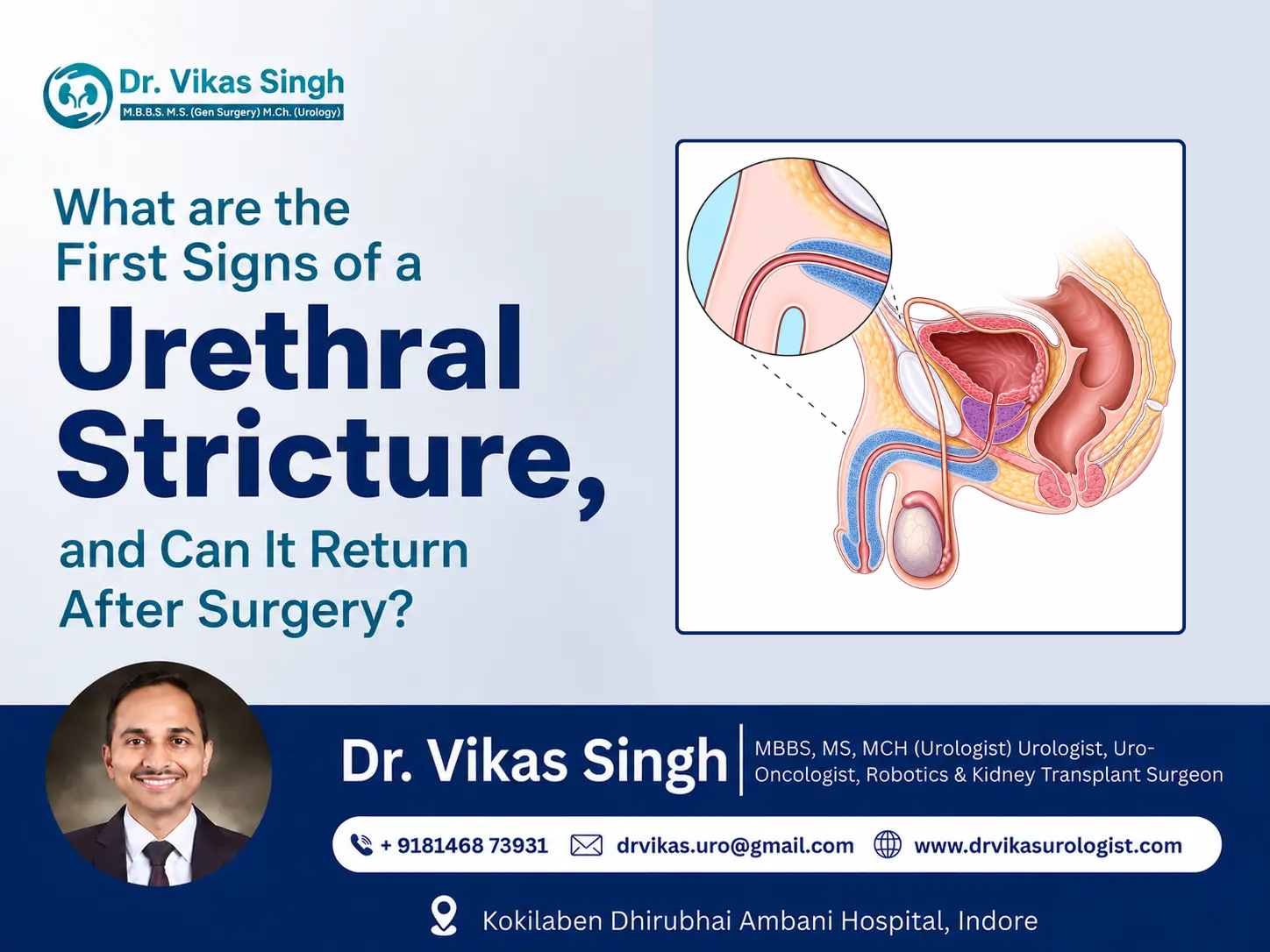

Urethral stricture (narrowing of the urethra) is most commonly caused by scar tissue from physical trauma, urethral instrumentation, sexually transmitted infections (especially gonorrhoea), prostate surgery, radiation therapy, or inflammatory skin conditions like lichen sclerosus. In some cases, no clear cause is found (idiopathic stricture). Early diagnosis and specialist treatment are essential to prevent bladder and kidney damage.
A narrowing of the urethra — clinically called urethral stricture — affects the tube that carries urine out of the body. When this tube becomes scarred or inflamed, urine flow is restricted, causing serious urological symptoms.
As a urethral stricture specialist in Indore with 15+ years of experience and over 10,000 urological procedures performed, I have treated hundreds of patients with this condition at all stages. This guide answers the most important questions about urethral stricture in clear, medically accurate language.
Urethral Stricture: Key Statistics (2024–2026)
| ~1%Men affected globally | 45–50%Cases caused by trauma or instrumentation | Up to 70%Recurrence after dilation alone | >90%Success rate of urethroplasty |
Sources: European Association of Urology (EAU) Guidelines 2024; Journal of Urology, 2025; AUA Urethral Stricture Guideline Update 2024
What Is Urethral Stricture?
Urethral stricture is a narrowing of the urethra caused by scar tissue (fibrosis) or inflammation. The urethra is the tube that carries urine from the bladder out of the body. In men, it also transports semen during ejaculation.
When scar tissue forms inside the urethra, it reduces the internal diameter of the tube, making it harder for urine to pass through. This is not a cancer and not an infection — it is a structural narrowing.
Read More: https://drvikasurologist.com/what-is-urethral-stricture-and-how-is-it-treated/
Who Is Most Affected?
• Urethral stricture is far more common in men than women, due to the longer male urethra.
• It can occur at any age, from young adults to elderly men.
• In India, prevalence is higher due to higher rates of road traffic accidents and delayed treatment of urological infections.
What Are the Main Causes of Urethral Narrowing?
| The most common causes of urethral stricture are: trauma/injury (30–40%), urethral instrumentation (30–35%), infections/STIs (15–20%), prostate surgery/radiation (10–15%), lichen sclerosus (5–10%), and idiopathic/unknown causes (5–10%). |
1. Physical Trauma and Pelvic Injury
Trauma to the urethra or pelvis is the single most common cause of posterior urethral stricture in men.
Common traumatic causes include:
- Pelvic fractures from road traffic accidents — these can shear or rupture the urethra at the bulbomembranous junction
- Straddle injuries — a direct blow to the perineum (e.g., falling onto a bicycle frame or fence)
- Sports injuries involving the groin or pelvic region
- Surgical complications during pelvic or colorectal surgery
When urethral tissue is torn or bruised, the healing process deposits scar tissue that gradually narrows the lumen. The scarring often worsens over time if untreated.
2. Urethral Instrumentation and Medical Procedures
Any medical procedure that passes an instrument through the urethra carries a risk of causing micro-injury and subsequent stricture formation.
Procedures associated with urethral stricture:
- Urinary catheterisation — especially repeated or long-term catheter use
- Cystoscopy — camera examination of the bladder
- Transurethral resection of the prostate (TURP) for benign prostatic hyperplasia (BPH)
- Endoscopic procedures for kidney stone removal (ureteroscopy)
- Transurethral resection of bladder tumour (TURBT)
Iatrogenic (procedure-related) strictures account for approximately 30–35% of all cases seen in urology clinics. The risk increases with repeated procedures or when instruments are passed by less experienced operators.
3. Sexually Transmitted Infections (STIs) — Particularly Gonorrhoea
Infectious urethritis — inflammation of the urethra caused by sexually transmitted infections — was historically the most common cause of urethral stricture worldwide.
Key infectious causes:
- Gonorrhoea (Neisseria gonorrhoeae) — chronic or recurrent infection causes progressive scarring along the anterior urethra
- Chlamydia — associated with non-specific urethritis (NSU) and sub-clinical inflammation
- Recurrent urinary tract infections — may contribute to urethral inflammation over time
A 2024 systematic review in the BJU International confirmed that untreated gonorrhoeal urethritis remains a significant cause of anterior urethral stricture in developing countries, including India.
4. Prostate Surgery and Radiation Therapy
Men who undergo surgical treatment for prostate cancer or benign prostate enlargement are at risk of developing stricture at the anastomotic site — where the urethra is rejoined after surgery.
- Radical prostatectomy carries a 0.5–9% risk of anastomotic stricture
- Radiation therapy for prostate or bladder cancer can cause delayed urethral fibrosis — sometimes appearing years after treatment
- Brachytherapy (seed implantation) has a lower but measurable stricture risk
5. Lichen Sclerosus (Balanitis Xerotica Obliterans — BXO)
Lichen sclerosus is a chronic, progressive inflammatory skin condition affecting the genital region. When it involves the urethra, it causes the most severe and recurrent form of anterior urethral stricture.
- BXO-related strictures often extend the full length of the anterior urethra
- They do not respond well to endoscopic treatments — urethroplasty with buccal mucosal graft is usually required
- Prevalence is estimated at 0.1–0.3% of the male population, but accounts for up to 15% of urethroplasty cases
6. Congenital Urethral Abnormalities
Some individuals are born with a narrowed urethra or urethral valves (posterior urethral valves in boys). These congenital conditions may not be diagnosed until childhood or early adulthood when symptoms develop.
7. Idiopathic Urethral Stricture (Unknown Cause)
In 5–10% of cases, no identifiable cause is found. These idiopathic strictures may result from unrecognised minor trauma or subclinical infections earlier in life.
Symptoms of Urethral Stricture: Recognise the Warning Signs
| If you have any of these symptoms, consult a urethral stricture doctor in Indore promptly. Early treatment prevents bladder and kidney damage. |
Common symptoms include:
- Weak, thin, or slow urine stream — the most characteristic symptom
- Difficulty starting urination (hesitancy)
- Feeling of incomplete bladder emptying
- Frequent urination and urgency
- Painful urination (dysuria) or burning sensation
- Recurrent urinary tract infections (UTIs)
- Spraying or forked urine stream
- Dribbling after urination
- Blood in urine or semen (in some cases)
- Acute urinary retention (complete inability to urinate) — a medical emergency
How Is Urethral Stricture Diagnosed?
Accurate diagnosis determines the correct treatment. As a best stricture urethra specialist in Indore, I use a structured diagnostic pathway for every patient.
Step-by-Step Diagnostic Approach
Step 1 — Clinical history: Duration of symptoms, history of trauma, catheterisation, STIs, or prior prostate surgery
Step 2 — Uroflowmetry: Measures peak urine flow rate. A flow rate below 10 mL/second suggests obstruction
Step 3 — Retrograde Urethrogram (RGU): X-ray with contrast dye to map the location, length, and severity of the stricture
Step 4 — Flexible Cystoscopy: Direct camera visualisation of the urethra and bladder
Step 5 — Post-void residual ultrasound: Measures residual urine volume after urination
Step 6 — Renal ultrasound: Checks for back-pressure effects on the kidneys
Urethral Stricture Treatment in Indore: Evidence-Based Options
The right treatment depends on the stricture’s length, location, cause, and recurrence history. As a urethral stricture surgeon in Indore offering both minimally invasive and reconstructive options, I personalise treatment for every patient.
1. Urethral Dilation
- Gradual widening of the narrowed segment using progressively larger dilators
- Best for: very short, simple strictures as a temporary measure
- Recurrence rate: 50–70% within 1–2 years
- Often used as a first step or bridge to definitive treatment
2. Direct Vision Internal Urethrotomy (DVIU)
- Minimally invasive endoscopic procedure — a small knife or laser cuts through the scar tissue under direct vision
- Best for: short strictures (under 1.5 cm) with no prior recurrence
- Recovery: 48–72 hours; catheter removed within 3–5 days
- Recurrence rate: 30–60% for single stricture; higher for recurrent cases
3. Laser Urethrotomy
- Uses precision laser energy (Holmium or Thulium) to ablate scar tissue with minimal thermal damage to surrounding tissue
- Offers faster healing and lower bleeding risk compared to cold-knife urethrotomy
- Available at Dr. Vikas Singh’s clinic in Indore as part of our advanced laser urology programme
4. Urethroplasty — The Gold Standard
- Surgical reconstruction of the urethra — the definitive, long-term solution for complex or recurrent strictures
- Techniques: excision and primary anastomosis (EPA) for short strictures; buccal mucosal graft (BMG) urethroplasty for longer strictures
- Success rate: 85–95% at 5 years in specialist centres
- Best for: strictures over 2 cm, recurrent strictures, BXO-related strictures, post-radiation strictures
Frequently Asked Questions About Urethral Stricture
Q1: Can urethral stricture be cured permanently?
Q2: How do I know if my slow urine flow is due to urethral stricture or an enlarged prostate?
Q3: Is urethral stricture surgery painful? What is the recovery time?
Q4: What happens if urethral stricture is left untreated?
Book a Consultation with Dr. Vikas Singh — Best Urethral Stricture Doctor in Indore
If you are experiencing a weak urine stream, difficulty urinating, or recurrent UTIs — do not ignore these symptoms.
Dr. Vikas Singh offers the full spectrum of urethral stricture treatment in Indore — from advanced laser urethrotomy to complex urethroplasty reconstruction.
- 15+ Years of Specialist Urology Experience
- 10,000+ Urological Procedures Performed
- Advanced Laser & Minimally Invasive Options
- Confidential Appointments | Personalised Treatment Plans
- Call Now or Visit Our Clinic in Indore for a Same-Week Appointment
Reach us at: Dr. Vikas Singh, Urologist