
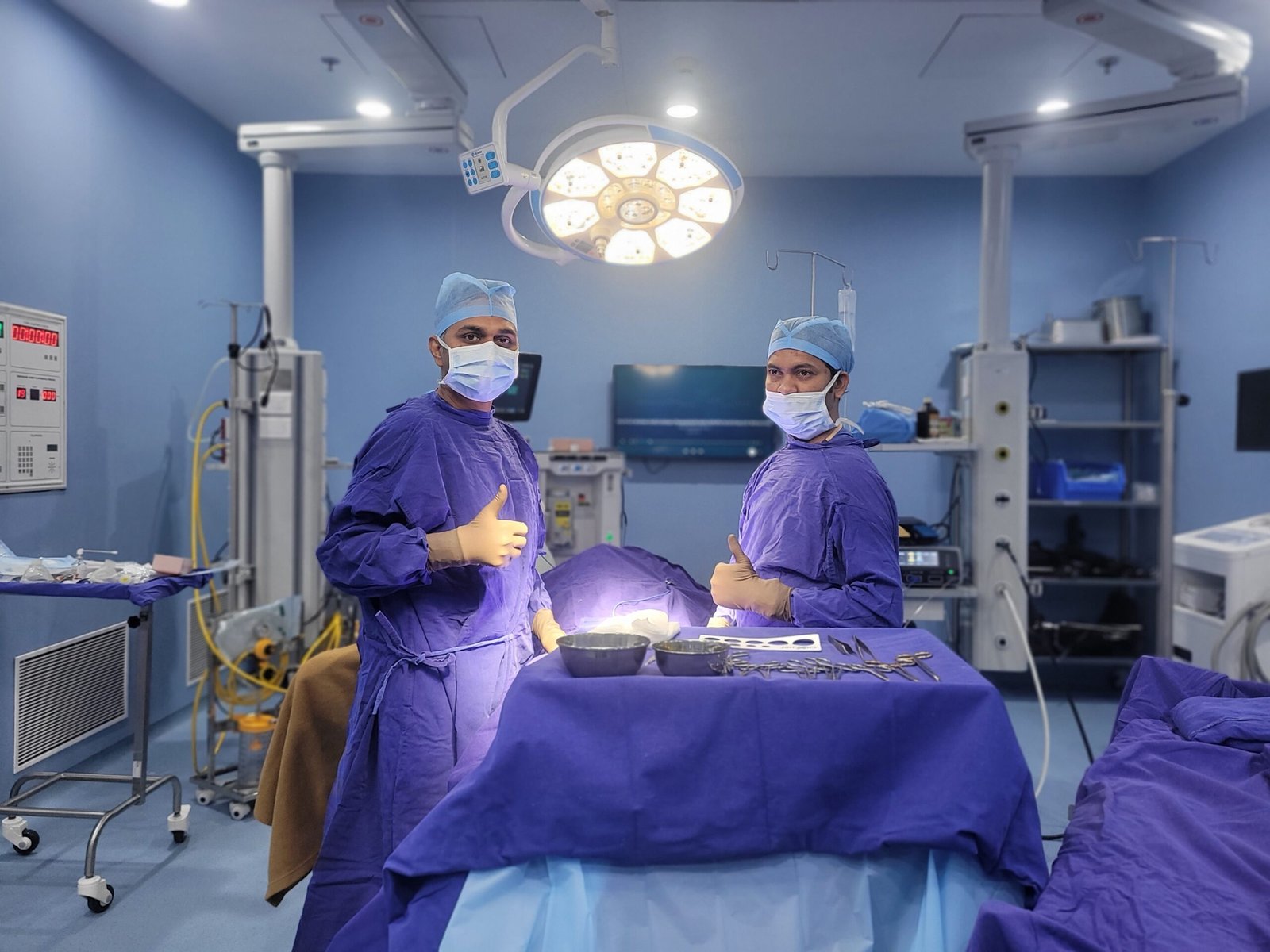
Despite circumcision being among the most frequently done surgeries worldwide, Indian men refrain from getting circumcised due to reasons like misinformation, fear of the surgery being painful, or embarrassment. Here at Kokilaben Dhirubhai Ambani Hospital, we assure our patients of the advanced Laser and Stapler (ZSR) technology, due to which you will not feel the pain of undergoing circumcision. Additionally, Laser and Stapler (ZSR) circumcision can be done in a fraction of the time it takes to complete traditional circumcision, and the surgical results are beyond our patients’ expectations.
We offer circumcision services to children and adults in a professional, discreet environment. Dr. Vikas Singh promises safe and quick surgical circumcision for patients with a number of reasons for the surgery, including, but not limited to, phimosis and recurrent balanitis. Dr. Vikas Singh will ensure the cleaning and hygiene of the circumcised person. Dr. Vikas Singh is the best licensed surgeon for circumcision in Kohilaben Dhirubhai Ambani in Indore, India, to perform circumcision, and Dr. Vikas Singh is your best option for instant and safe circumcision.
The foreskin is the fold of skin covering the head of the penis. Most baby boys are born with it naturally fused to the glans, which gradually separates over the first several years of life.
Circumcision, the surgical removal of the foreskin, has religious, cultural, and medical roots going back thousands of years. Medically, it may be recommended when the foreskin is too tight to retract, gets trapped behind the glans, or leads to recurring infections. Some also choose it for hygiene or personal, cultural, or religious reasons, all valid motivations.
Modern techniques like Laser Circumcision and Stapler Circumcision (ZSR) have made the procedure quicker and more comfortable. Most adults go home within a few hours, with minimal pain and a recovery time of just 7 to 10 days.
Although the reasons for wanting to perform circumcision can be many, the reasons for carrying out circumcision that are truly important for the health and well-being of the patient in question are even fewer. Here are the conditions in which circumcision may be medically required:
Phimosis, a foreskin too tight to retract, is the most common reason for circumcision. It’s normal in young boys and usually resolves on its own by adulthood. When it develops later in life due to scarring or inflammation, though, it can become a real medical concern.
Adult phimosis can cause pain during erections or sex, difficulty urinating, foreskin ballooning, poor hygiene, odor, and recurring infections. Mild cases are often treated first with a topical steroid cream over 4 to 8 weeks. When that doesn’t resolve it, or the condition is more severe, circumcision is usually the most effective solution.
Paraphimosis is a urological emergency where the retracted foreskin gets stuck behind the glans and can’t return to its normal position. This creates a tight ring that cuts off blood flow, and without prompt treatment, it can lead to serious tissue damage or gangrene. It often happens after procedures like catheterization or cystoscopy, or following sexual activity, when the foreskin isn’t repositioned properly. Emergency treatment involves reducing the swelling to reposition the foreskin, but circumcision is usually recommended afterward to prevent it from happening again.
Strictures often develop after medical procedures, including:
Balanitis is inflammation of the glans and foreskin, often caused by infection or poor hygiene, and is usually treated with topical medication and better hygiene. When it keeps recurring, it can cause painful scarring and even difficulty urinating, making circumcision the more lasting solution. Diabetic patients are especially prone to this, as high blood sugar creates ideal conditions for infections, making circumcision particularly beneficial for them.
There is evidence that HPV (Human Papillomavirus), phimosis, hygiene, and lichen sclerosus contribute to penile cancer. Without circumcision, HPV can become trapped in the foreskin and lead to cancer, increasing the chance of it developing. This problem is not present in circumcised men, with a much lower incidence of penile cancer.
For men who have phimosis or lichen sclerosus, circumcision, along with dermatological and urological monitoring, is suggested.
Dr. Vikas Singh (circumcision researcher) carries out circumcision with the newest technology. Two methods of circumcision (Laser and Stapler) are used. Both methods are faster and cause less post-operation pain and bleeding.
During Laser Circuit, the foreskin is removed using a laser. After the laser cuts the tissue, the bleeding vessels are sealed. Because of this process, there is virtually no bleeding.
Local or general anesthesia is used, and there is no pain. Adults get local anesthesia with sedation, and children get general anesthesia. The operation usually takes20-30 min.
Small, self-dissolving sutures are used to seal the skin and are not needed for removal. Post-operative care instructions and a dressing are also provided.
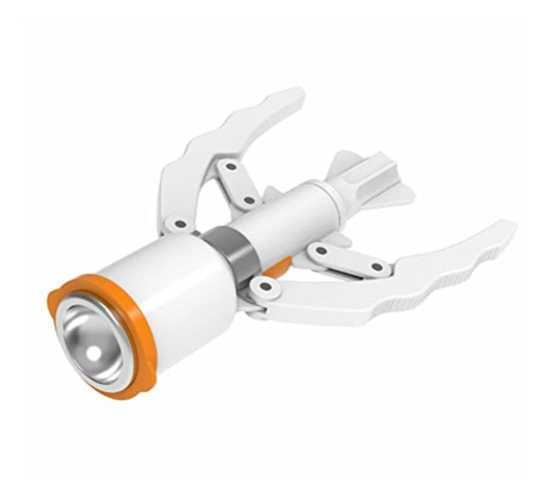
ZSR Stapler Circumcision is the fastest circumcision method available, cutting and stapling the foreskin in a single step. The whole procedure takes just 5 to 10 minutes under local anesthesia and delivers cleaner, more consistent results than traditional techniques.
Why patients choose it:
When it comes to circumcision safety concerns and outcome complaints, Laser and Stapler circumcision have more advantages over traditional circumcision techniques. This is a simple guide to help you talk to Dr. Vikas Singh about the differences:
Factor | LASER Circumcision | Stapler (ZSR) Circumcision |
Procedure Time | 20–30 minutes | 5–10 minutes |
Anaesthesia | Local (adults) or General (children) | Local anaesthesia (most adults) |
Bleeding | Minimal – laser seals vessels as it cuts | Minimal – stapler compresses tissue simultaneously |
Stitches | Fine, self-dissolving sutures | No sutures – staples fall off naturally in 7–10 days |
Pain Level | Very low post-operative pain | Very low post-operative pain |
Cosmetic Result | Excellent – precise laser cutting | Excellent – uniform circular result |
Recovery Time | 7–14 days | 7–10 days |
Hospital Stay | Day procedure (2–4 hours) | Day procedure (2–3 hours) |
Best For | All ages; complex anatomy; phimosis with scarring | Adults; standard anatomy; patients wanting the fastest procedure |
Infection Risk | Very low | Very low |
Fear of pain is often what holds men back from getting circumcised, but the reality is usually far milder than expected.
Before the procedure: A medical history and basic blood tests are taken. If general anesthesia is used, fasting overnight is required, and a mild sedative helps calm any nerves.
During the procedure: You won’t feel pain, only a brief pinch when the local anesthetic is given, after that, the area is fully numb.
After the procedure: Mild soreness is common once the anesthesia wears off, usually rated just 2-3 out of 10, much less than most patients expect. Some swelling in the first few days is normal, and most people feel comfortable and mobile again within 2 to 3 days.
Patients who undergo Laser or Stapler circumcision at Kokilaben Hospital often find recovery easier and faster than they imagined, getting back to normal activities sooner than expected.
Circumcision can be done at any age, though the approach varies:
Recovery from modern Laser or Stapler circumcision is generally quick and smooth:
Both Laser Circumcision and Stapler (ZSR) Circumcision are the least invasive and patient-friendly as compared to all the methods that are used. They both have better outcomes than traditional surgical circumcision methods when compared in terms of pain, bleeding, and recovery time.
Both Laser and Stapler circumcision are day-care procedures at Kokilaben Hospital. You arrive in the morning and go home the same afternoon. Delaying an overnight stay in the hospital is the most common.
From the Near Repose that of Dr. Vikas Singh’s staff is available to the near repose that is gap concerned and easy to manage to the gap that is for the healing concerns of staff, to the near repose for your all near repose.
Posted on GoogleTrustindex verifies that the original source of the review is Google. Dr vikas singh is best urologist in IndorePosted on GoogleTrustindex verifies that the original source of the review is Google. Nice treatmentPosted on GoogleTrustindex verifies that the original source of the review is Google. My treatment given by Dr vikas sir he is best doctorPosted on GoogleTrustindex verifies that the original source of the review is Google. Best doctorPosted on GoogleTrustindex verifies that the original source of the review is Google. Hm log shivpuri se dr vikas sir ko dikhane aaye, sir se milkar bahut acha lga, nature or treatment bahut sahi hePosted on GoogleTrustindex verifies that the original source of the review is Google. Nice doctorPosted on GoogleTrustindex verifies that the original source of the review is Google. Very experienced and caring doctor. Excellent treatment and patient-friendly approach. Highly recommended.”Posted on GoogleTrustindex verifies that the original source of the review is Google. On dt27.06.2026 dr.vikas singh performed my prostatomegaly surgery by Urolift method . I am now fealing very well.Within two days l got discharged from Kokilaban Dhirubhai Ambani hospital Indore (MP).I am very thankfull to this very new method Urolift,Dr.Vikas singh sir and BCM Kokilaben Dhirubhai Ambani hospital,Nipania Indore. ByAdarsh kumar pauranik.Posted on GoogleTrustindex verifies that the original source of the review is Google. Good experience for testis treatment for my son
Definitely. Modern urology procedures, including circumcision, are safe when you get it done from an expert surgeon. Nearly zero percent complications are reported with Laser or Stapler Procedures. Like with any surgical procedure, there is a small risk of bleeding, infection, or healing issues; however, they are incredibly rare and easily managed.
Laser Circumcision is done in 20 to 30 minutes. Stapler or ZSR circumcision is done in only 5 to 10 minutes. Total stay in the hospital, including the preparation and recovery time from anesthesia is 2 to 9 hours. Most patients go home the same day.
Most adults can take about 3 to 5 days off of work to recover enough to go back. Most of the time, the length of recovery depends on how physically demanding the work is. More physically demanding work can require a leave of 7 to 10 days. Dr. Vikas Singh will discuss with you the nature of your work and suggest the appropriate length of leave.
After getting the circumcision procedure done, you should not engage in any sexual activity, including intercourse and even masturbation, for about 4 to 6 weeks. Engaging in sexual activity sooner increases the chances of infection and also increases the chances of the circumcision not healing and the process being undone. At your followup appointment, Dr. Vikas Singh will advise you on when you can engage in sexual activity.
The sexual sensations and performance of a vast majority of men remain mostly unchanged. The tip of the penis tends to feel more sensitive to touch for a few weeks after a circumcision as it gets used to the change. This ‘sensitivity’ tends to become normal after the adjustment period. In fact, some men report that the sexual experience becomes more pleasurable, especially those who have Phimosis. In Phimosis, there is a painful inability to uncover the glans, as a result of an excessively tight prepuce – the loose skin covering or the foreskin.
Traditional circumcision tends to involve multiple use of a surgical blade, and scissors, followed by hand-stitched sutures. This type of circumcision tends to lead to more blood loss, extensive post-operative swelling, and prolonged recovery. Laser circumcision, on the other hand, tends to use a laser that cuts and closes blood vessels simultaneously. There is also a distinct difference in the amount of blood loss, swelling, and post-operative recovery discomfort, as well as recovery time. In Kokilaben Hospital, Laser and Stapler techniques are exclusively used by Dr. Vikas Singh to ensure that the outcomes are substantially better in relation to all comfort and recovery parameters for the patients
Typically, a person can be of any age when a circumcision is done. It can be a religious or a cultural requirement. As a result, often, the persons are infants or children. Medically, it is also performed for Phimosis or Balanitis when the medical conditions are resistant to the topical steroid therapy. This can also be performed when the person is a young child or an adult.
Some children or mild adult phimosis cases may be treated topically. A steroidal cream like betamethasone may be applied to the genital area twice a day. This steroidal cream loosens the foreskin, but efficacy may vary. If the phimosis is marked, lichen sclerosus or an infection is present, or topical treatment is unsuccessful, the only solution is circumcision.
Absolutely. Dr. Vikas Singh can perform circumcision on all children, even infants. A general anaesthetic is provided to make sure the child does not feel anything. The paediatric nurses on staff at the Kokilaben Hospital have experience dealing with children, and think of this process as an opportunity to provide further care for the child.