
Varicocele-related infertility can be prevented by early diagnosis, timely microscopic varicocelectomy (the gold-standard surgery with 70% sperm improvement rates), and supportive lifestyle changes. The longer treatment is delayed, the higher the risk of irreversible testicular damage.
What Is a Varicocele?
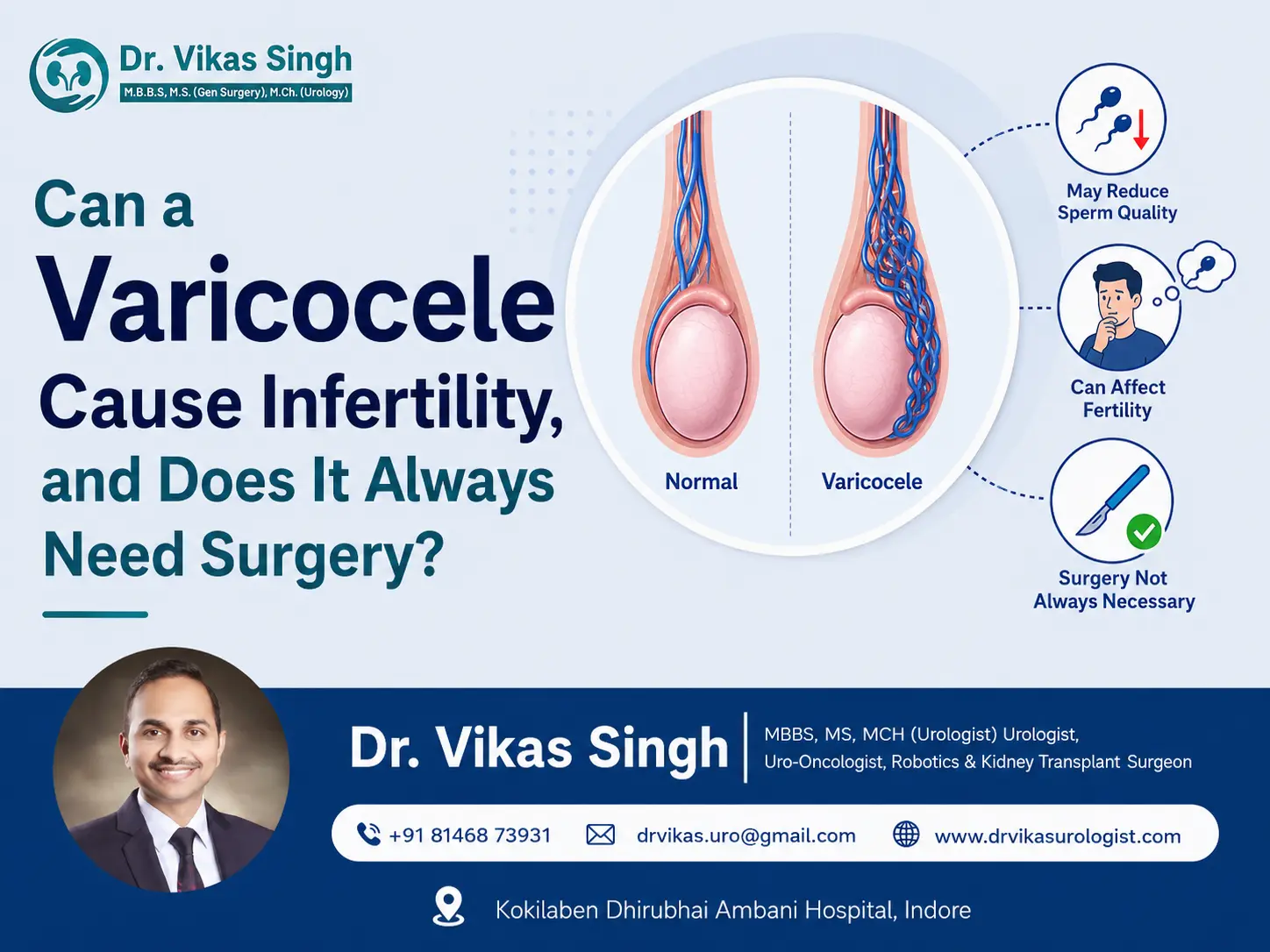
A varicocele is an abnormal enlargement of the veins inside the scrotum — the same way varicose veins develop in legs. These enlarged veins cause blood to pool around the testicles, raising local temperature and increasing oxidative stress on sperm cells.
Varicoceles are graded from Grade I (smallest, detectable only by ultrasound) to Grade III (visible to the naked eye). Higher-grade varicoceles are more likely to affect fertility.
Key Statistics (2026):
- 15% of all adult men have a varicocele (WHO, 2024)
- 35–40% of men with primary infertility have varicocele as the diagnosed cause
- 80% of men with secondary infertility (previously fertile) are found to have varicocele
- 90% of varicoceles occur on the left side due to venous anatomy
Why Does Varicocele Cause Male Infertility?
Varicocele impairs male fertility through four main mechanisms:
- Elevated scrotal temperature: Sperm production (spermatogenesis) requires a temperature 2–4°C below core body temperature. Pooled blood raises scrotal heat and inhibits sperm development.
- Oxidative stress: Increased reactive oxygen species (ROS) from pooled blood damage sperm DNA, reducing fertilisation potential.
- Hormonal disruption: Varicocele is linked to lower testosterone and elevated FSH/LH levels, further impairing sperm production.
- Testicular atrophy: Chronic venous congestion can cause the affected testicle to shrink, reducing its sperm-producing capacity over time.
These effects compound over years. A man in his 20s with an undiagnosed varicocele may have borderline semen parameters; the same man at 35 may have severely impaired fertility. Early intervention is critical.
How to Prevent Infertility from Varicocele: 5 Evidence-Based Steps
Preventing varicocele-induced infertility requires a proactive, step-by-step approach. Here is what Dr. Vikas Singh, one of the most experienced urologists in Indore, recommends:
Step 1: Get Screened Early — Don’t Wait for Symptoms
Most men with varicocele have no pain or visible signs. The only way to detect it is a clinical examination followed by a scrotal Doppler ultrasound. Screening is recommended if you:
- Have been trying to conceive for 6–12 months without success
- Have a semen analysis showing low sperm count, poor motility, or abnormal morphology
- Notice one testicle appearing smaller than the other
- Experience a dull scrotal ache, especially after standing for long periods
Dr. Vikas Singh, a trusted urologist doctor in Indore, advises all men above 20 who plan to start a family to consider a baseline semen analysis. This simple test can detect problems years before they become irreversible.
Step 2: Confirm Diagnosis with Doppler Ultrasound
A scrotal Doppler ultrasound is the gold-standard diagnostic tool. It measures:
- Vein diameter (>3 mm is significant)
- Retrograde blood flow (backflow on Valsalva manoeuvre)
- Testicular volume (to assess atrophy)
Paired with a semen analysis (sperm count, motility, morphology) and hormonal blood tests (FSH, LH, testosterone), this gives a complete picture of fertility impact.
Step 3: Choose Microscopic Varicocelectomy — The Gold-Standard Treatment
The most effective way to prevent varicocele infertility is microscopic varicocelectomy. This is not a last resort — it is the recommended first-line surgical treatment.
What is Microscopic Varicocelectomy?
Microscopic varicocelectomy (also called subinguinal microsurgical varicocelectomy) uses a high-powered operating microscope to identify and ligate the dilated veins with millimetre precision, while protecting the testicular artery, lymphatics, and vas deferens.
Evidence-Based Outcomes (2026 Data):
- 60–70% of patients show improved sperm parameters after microscopic varicocelectomy
- 40–50% natural pregnancy rate within 12–24 months post-surgery
- <1% risk of testicular artery injury with microsurgical technique (vs. 5–10% with open surgery)
- <5% varicocele recurrence rate with microscopic approach (vs. 15–25% with laparoscopic)
Why Dr. Vikas Singh Is the Right Choice for Microscopic Varicocelectomy Treatment in Indore?
- Over 15 years of specialised minimally invasive urology experience
- Performed 10,000+ urological procedures including complex male infertility cases
- State-of-the-art operating microscope technology at his Vijay Nagar clinic
- Day-care procedure — patients go home the same day
- Recognised as a famous urologist in Indore for patient outcomes and safety
Step 4: Adopt Fertility-Protective Lifestyle Habits
Lifestyle changes cannot cure varicocele, but they significantly protect sperm quality before and after treatment:
- Avoid heat exposure: Avoid hot tubs, saunas, and tight underwear — all raise scrotal temperature.
- Stop smoking: Smoking reduces sperm motility by up to 22% (WHO, 2024).
- Limit alcohol: Heavy drinking lowers testosterone and impairs spermatogenesis.
- Eat antioxidant-rich foods: Vitamins C, E, zinc, selenium, and CoQ10 protect sperm from oxidative damage.
- Exercise moderately: Avoid intense cycling or contact sports that pressure the scrotal area.
- Manage weight: Obesity raises scrotal temperature and disrupts hormonal balance.
Step 5: Post-Treatment Monitoring and Adjunct Therapy
After varicocelectomy, sperm recovery takes 3–6 months (one full spermatogenesis cycle). Follow-up semen analysis at 3, 6, and 12 months tracks improvement.
If sperm parameters improve insufficiently, adjunct options include:
- Antioxidant supplementation (CoQ10, Vitamin E, zinc)
- Hormonal therapy for low testosterone
- Intrauterine insemination (IUI) if mild infertility persists
- IVF-ICSI for severe male infertility or female factor infertility alongside
When to See a Urologist in Indore: Warning Signs Checklist
Consult a best urologist doctor in Indore immediately if you experience any of the following:
- Trying to conceive for 12 months (or 6 months if aged over 35) without success
- Semen analysis showing sperm count below 15 million/mL or motility below 40%
- One testicle visibly smaller than the other
- Dull ache or heaviness in the scrotum after standing or exercise
- Low testosterone confirmed on blood testing
- Visible rope-like veins in the scrotum
Do not self-diagnose or delay. Varicocele is a progressive condition — early evaluation by a top urologist in Indore like Dr. Vikas Singh gives you the best chance of a full fertility recovery.
Varicocele Treatment Options: Which Is Best?
Here is a quick comparison of available varicocele treatments to help you make an informed decision:
| Treatment | Recurrence Rate | Complication Risk | Recovery Time | Fertility Outcome |
| Microscopic Varicocelectomy | <5% | Very Low (<1%) | 3–5 days | Best (Gold Standard) |
| Open Surgery | 10–15% | Moderate (5–10%) | 5–7 days | Good |
| Laparoscopic Surgery | 15–25% | Moderate | 3–5 days | Moderate |
| Percutaneous Embolisation | 10–15% | Low–Moderate | 1–2 days | Moderate |
Source: American Urological Association (AUA) Guidelines on Male Infertility, 2024 Update.
About the Author: Dr. Vikas Singh — Top Urologist in Indore
Dr. Vikas Singh is one of the most experienced and recognised urologists in Indore, with a practice dedicated to advanced urology, kidney transplantation, and uro-oncology. His credentials include:
- Qualifications: MS (General Surgery), MCh (Urology), specialised training in minimally invasive and microsurgical urology
- Experience: 15+ years of active clinical practice in Indore
- Procedures performed: 10,000+ urological surgeries, including 500+ kidney transplants
- Specialisations: Microscopic varicocelectomy, kidney stone laser treatment, prostate disorders, urological cancers, and renal conditions
- Location: Vijay Nagar, Indore — accessible from all areas of Madhya Pradesh
Dr. Vikas Singh is widely regarded as a top 10 urologist in Indore for his patient outcomes, ethical practice, and consistent adoption of the latest evidence-based treatment protocols. Patients travel from across Central India to consult him for complex urological conditions.
Frequently Asked Questions (FAQ Schema)
Q1: Can varicocele cause permanent male infertility if left untreated?
Q2: Is surgery always needed, or can varicocele infertility be treated without an operation?
Q3: How do I find the best urologist in Indore for varicocele treatment?
Q4: How do I find the best urologist in Indore for varicocele treatment?
Q5: How soon after varicocelectomy can I expect improved sperm counts?
Varicocele is treatable. Infertility from varicocele is preventable. The single most important step you can take right now is to get evaluated by a qualified, experienced urologist.
Book Your Consultation with Dr. Vikas Singh
- Top urologist in Indore with 15+ years of specialised experience
- Expert in microscopic varicocelectomy treatment in Indore
- 10,000+ urological procedures performed with outstanding outcomes
- Same-day consultations available for urgent cases
Do not wait. Every month of delay is a month of continued testicular stress. Schedule your appointment with one of the most trusted and experienced urologists in Indore and take the first step towards restoring your fertility with confidence.
Reach us at: Dr. Vikas Singh, Urologist